
Access control system integration means connecting your door readers, controllers and credentials to the other systems on your site, so they share data and act on it together. The most common links are video surveillance, intrusion and fire alarms, visitor management, building systems and IT directories. Done well, one event at a door triggers the right camera view, the right alert and the right record, with no one retyping anything between screens.
This guide is for business owners, property managers and facility operators in the United States. It explains what integration is, what to connect first, what the fire and life safety rules mean for door hardware, and how to plan a project that works on day one and stays maintainable.
TL;DR
- Integration joins access control with video, alarms, visitor management, building systems and IT so they work as one platform instead of separate ones.
- Video is the link most security professionals already have in place: a 2023 ASIS survey found 54 percent had video and access control integrated.
- Any electrified lock on an egress path has to release on fire alarm and power loss, so involve your fire alarm contractor early.
- Plan around open standards and a written scope, not around one device, so you can add sites and systems later.
- Start with the two or three links that solve your biggest daily problem, then expand in phases.
What access control integration actually is
An access control system on its own answers one question: may this credential open this door right now? Integration lets that answer, and the event behind it, feed other systems. One vendor’s integrations team describes an integration as taking two disparate systems and joining them together into a unified solution for the end user. The same white paper notes that building a single integration between two products can take 80 to 100 hours of development, which is why open, supported connections matter when you choose equipment.
In practice an integrated installation has five layers:
- Controllers and readers. The hardware at the door that checks cards, mobile credentials or biometrics.
- Management software. The platform where you set permissions, watch events and run reports.
- Middleware or APIs. The bridges that let different systems exchange data.
- Network infrastructure. Secure IP connectivity between devices, servers and sites.
- A database layer. Where credentials, logs and integration settings live.
This layered breakdown follows a published guide to access control integration. The practical point: the cabling and network under the doors matter as much as the readers on them. That is why access control projects and structured cabling projects are best designed together.
Which systems can you connect to access control
Most commercial platforms can link to the same families of systems. One manufacturer’s integration list covers video security, analytics, alarm systems, building management and communications. Here is what each link does for a working business.
| Integration | What it does | Typical benefit |
|---|---|---|
| Video (CCTV, analytics) | Attaches live and recorded footage to door events | Operators verify an alarm in seconds |
| Intrusion and perimeter alarms | Arms or disarms zones when credentials are used; shares alarm events | Fewer false alarms, faster response |
| Fire alarm | Releases electrified locks on alarm | Life safety compliance at egress doors |
| Visitor management | Issues temporary credentials and logs guests | Cleaner reception, a record of who was on site |
| Building management (HVAC, lighting, elevators) | Responds to occupancy and credentials | Lower running cost, controlled floors |
| Intercom and door entry | Lets staff see and admit callers | Less walking to doors, a video record |
| IT directory and HR systems | Syncs users and removes leavers automatically | Access rights that follow employment status |
| Time and attendance | Reuses door events as attendance data | Less duplicate data entry |
How common each link really is
The ASIS International 2023 Access Control Research Report surveyed 1,022 security professionals. It found 54 percent had video and access control integrated, 42 percent had visitor management integrated, 31 percent time and attendance, 26 percent emergency communication, and 22 percent access to IT systems. In the same survey, security consultants rated integration of access control with surveillance as the most important technological innovation, at 8.63 out of 10.
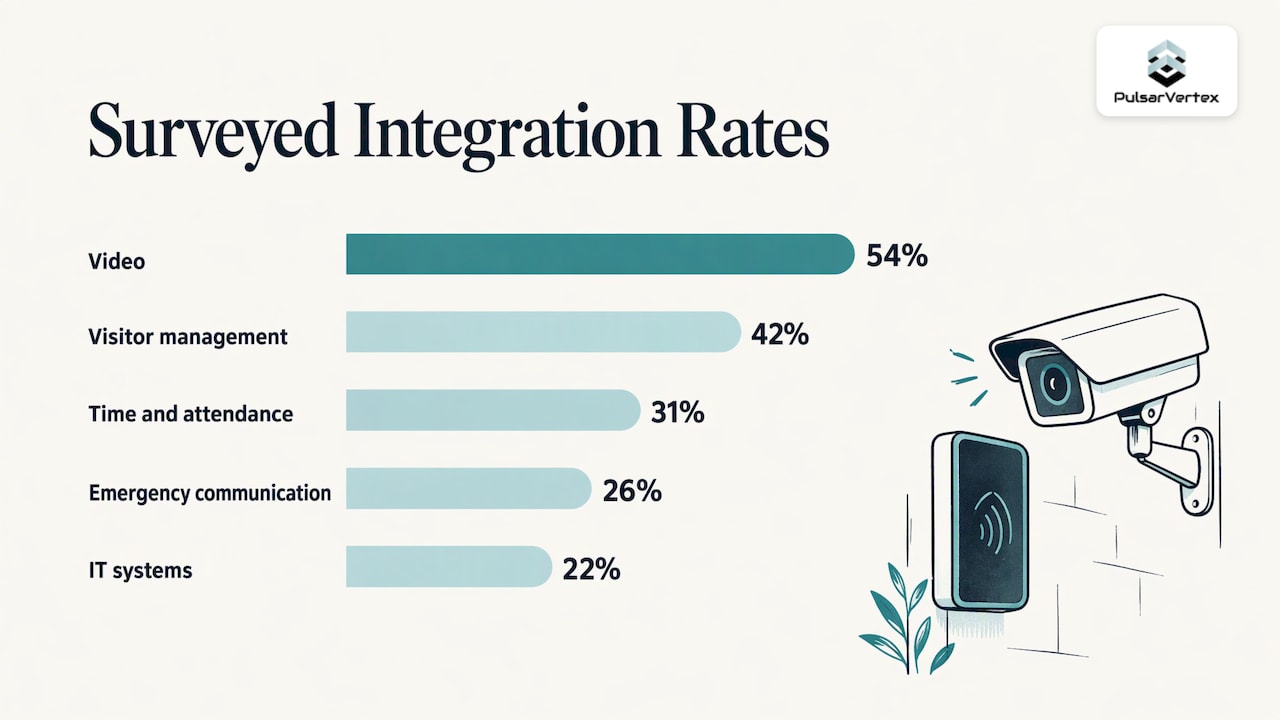
The reading for a business owner: video is the proven first step, visitor management is next for sites with guests or contractors, and IT and emergency links are where many sites still have room to grow.
Why video is usually the first integration
Without integration, a “door forced open” alarm is a line of text in a queue. With it, the camera feed appears on the operator’s screen automatically, so the operator can see at once whether someone forced the door or a badge tap simply failed to register.
That difference shows up in daily work:
- Alarm verification. Operators or remote monitoring staff confirm a real event before sending anyone.
- Investigations. Searching a door event and jumping to the matching clip replaces scrolling hours of footage.
- Tailgating and propped doors. Analytics on the camera can flag two people entering on one credential.
- Dispute resolution. A record of the credential and the video together settles who was where.
If you are planning cameras and doors together, our commercial CCTV installation service and our access control installation are designed to be specified as one project.
Integration in commercial and industrial buildings
The value shows up differently depending on the site.
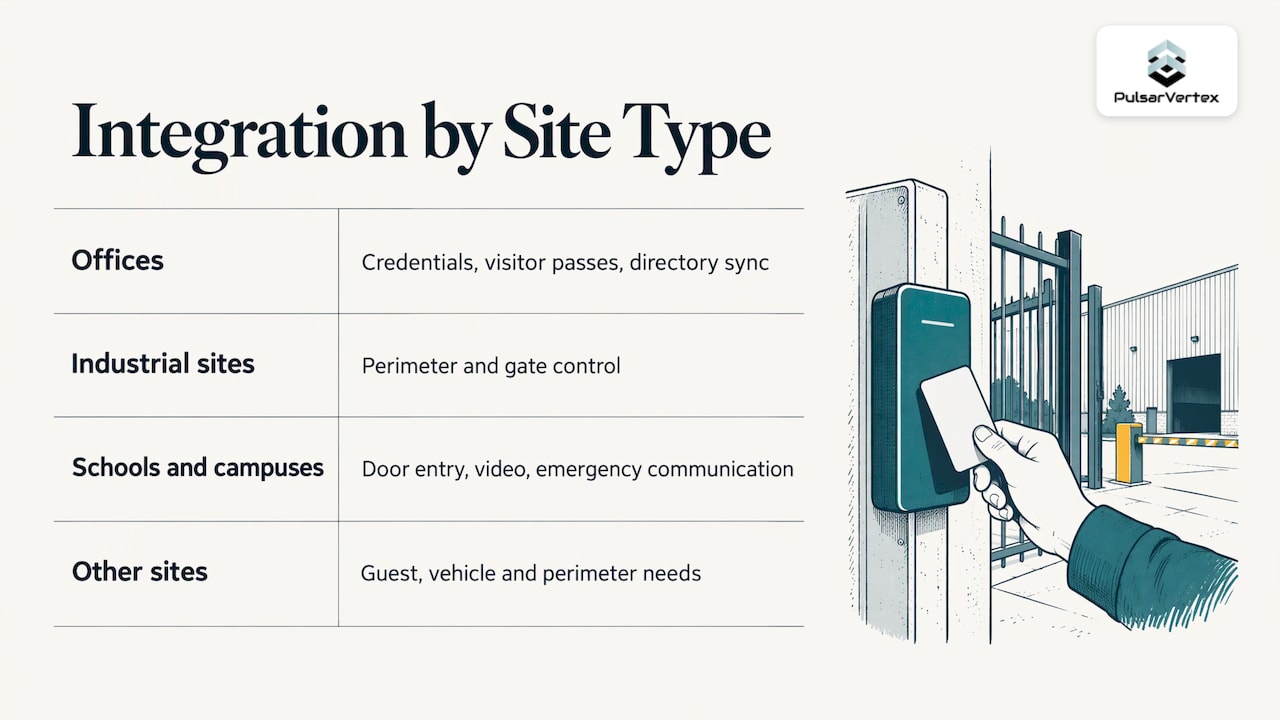
Offices. Mobile or card credentials control the lobby, floors and server rooms. Visitor management issues temporary passes, and the directory sync removes access when someone leaves. See how we approach office security with CCTV, fire alarms and access control.
Industrial sites and warehouses. Large footprints, vehicles and contractors make perimeter and gate control the priority. Linking readers, ANPR cameras and perimeter detection lets one control point see who is entering a yard and where they are going. Our guide to industrial security systems covers components, design and upkeep, and perimeter detection and intruder alarms cover the outer layer.
Schools and campuses. Many entrances, visitors every day and a need to lock down quickly. Door entry, video and emergency communication work best on one plan, as described in our school security overview and our guide to emergency communication systems.
Hotels, car parks and farms. Each has its own mix of guest, vehicle and perimeter needs; see our pages on hotel security, car park security and agricultural security.
Across all of them, the common thread is a single operator view. Security Sales & Integration names video for instant event verification, alarms for faster response, building systems for efficiency and visitor management for smoother guest entry as the most valuable opportunities.
Fire alarm integration and door safety
This is the part of an integration where the rules are fixed and the cost of getting it wrong is highest. Doors on an exit path must let people out. Under the model codes used across much of the United States, access-controlled egress doors with magnetic locks must unlock on a fire alarm signal and on loss of power, and a push button within 5 feet of the door must release the lock independently of the access control system.
A separate rule covers fire doors. Under the 2024 IBC and IFC, when electrified hardware controls the latching of a fire door assembly, it should be connected to the fire alarm system so the latch projects automatically if a fire occurs. The same source notes the codes do not require a building to have a fire alarm or sprinkler system just so that this kind of hardware can be installed.
What this means for your project:
- Bring the fire alarm designer and the access control designer to the same table before hardware is ordered.
- List every door that is on an exit path and record how each one releases.
- Confirm which edition of the codes your jurisdiction has adopted, and ask the local fire marshal or building department when in doubt. Adoption varies by state and city.
- Test the fire release as part of commissioning and again during routine maintenance.
Because we install fire alarms as well as access control, the relay and release points are designed once rather than argued between two contractors. Our guide to commercial fire alarm systems explains the fire side in more depth.
Standards and cybersecurity to build in
Integration connects systems that used to be isolated, so each connection is also a new path for data. Two things keep it manageable.
Open protocols
Middleware and unified platforms usually talk to equipment using ONVIF for video, OSDP for access control and BACnet for building systems. Specifying products that support these open protocols keeps you from being locked to one manufacturer, and it keeps the cost of adding a camera, reader or building system predictable. Security management platforms of this kind are often called PSIM software, which brings video, access control, intrusion and fire alarm systems into one user interface.
Secure interconnections
The US National Institute of Standards and Technology describes any system interconnection as two systems plus the mechanism that joins them. Its security controls include firewalls, intrusion detection, auditing, identification and authentication, logical access controls, encryption, and physical and environmental security. For a business, that translates into plain actions:
- Put security devices on their own network segment, not on the guest Wi-Fi or the general office LAN.
- Give every operator a named account with only the rights the role needs.
- Keep firmware and server software patched under a maintenance agreement.
- Log who changes door schedules and permissions.
- Use encrypted communication between readers and controllers where the equipment supports it.
This is also where network design pays off. Our work in structured cabling, fibre-optic networks and commercial Wi-Fi means the backbone your doors and cameras depend on can be built and documented with the security design.
Privacy: handle credential data on purpose
Access logs, video and biometric templates are personal data. Privacy rules for video and biometrics differ across US states, and some states have specific biometric laws, so confirm the rules that apply where you operate with your legal counsel before you enroll employees or visitors in a biometric system. As a general practice, write down why each type of data is collected, who can see it, and how long it is kept. If a non-biometric credential does the job, it is the simpler choice. For schools, our article on the pros, cons and legal aspects of CCTV cameras in schools goes deeper on video.
How to plan an integrated access control project
A plan that starts small and has a clear scope usually outperforms a sprawling one. In a different field, a BCG white paper observed that isolated point deployments with no big-picture plan rarely deliver the big-picture benefits, and that large monolithic programs often get shut down within 12 to 18 months when they fail to show early value. The same logic holds for security: a roadmap with early wins beats a single giant cutover.
- Define the problems. Write down the incidents and daily frictions: propped doors, lost cards, unverified alarms, slow visitor sign-in.
- Survey the site. Count doors, gates, vehicle entries and existing cameras. Note which doors are on exit paths.
- Choose the integrations that solve those problems. Typically video first, then fire release and alarms, then visitors and IT.
- Pick open, supported products. Check protocol support and whether the integration is maintained by the manufacturer, not a one-off.
- Design the network and power. Allow for cable routes, PoE, backup power and segmentation.
- Commission and test. Test every door’s fire release, every alarm-to-camera link and every operator role.
- Train and document. Operators, reception and facilities staff need to know the workflows. Keep as-built drawings.
- Set up maintenance. Integrated systems drift when firmware, directories and staffing change. A maintenance agreement keeps the links working.
Working with outside specialists
Larger builds often bring in an outside engineering consultancy for project management, risk management and regulatory compliance alongside the security contractor. Whoever is on the team, agree early who owns the single schedule, who signs off the fire release testing, and who is the contact after handover.
Perspective
Our view: integrate around the doors, not around a product.
In our experience at Pulsar Vertex Fire & Security Innovations, the sites that get the most from their security are the ones where access control, video, alarms and fire safety were designed together. We install all of them, so a single team can plan the cabling, set the door release logic, tune the camera views and test the whole chain.
Our approach is bespoke: we start with how your site operates, which doors matter most, who comes and goes, and which regulations apply, and then we choose the technology. Tailored design is how we aim for solutions that are compliant, easy for your staff to operate and ready to expand.
We also treat maintenance as part of the design. Integrations are only as good as their last test, so we offer ongoing service and 24/7 maintenance and repairs, so your systems keep working together after handover.
Pulsar Vertex
Choosing an integration partner
A few questions help you judge any installer:
- Can one company handle access control, CCTV, fire alarm and cabling, or will you be coordinating several?
- Will they design around open protocols and document the system?
- Do they have a plan for fire alarm release, testing and maintenance?
- What does ongoing support look like after commissioning?
- Can they phase the work so each stage delivers value?
Pulsar Vertex USA works with commercial, industrial, agricultural and educational facilities, with more than 20 years of experience behind our approach to planning and execution. Our commercial key fob and key card access control page and our door entry and video intercom page show what a typical door-level installation includes.
Get an integrated design for your site
Pulsar Vertex USA designs, installs and maintains access control that works with CCTV, perimeter detection, fire alarms and your network. Tell us about your doors, gates and risks, and we will map out the integrations worth doing first, in phases that fit your budget.
Start with our access control installation service or contact the team through pulsarvertex.com.
FAQ
What is the difference between access control and integrated access control?
Standalone access control only decides who may open each door. Integrated access control shares door events with other systems, such as cameras, alarms, visitor logs and IT directories. That lets one event trigger several actions and gives operators one place to manage everything.
Which integration should we start with?
For most businesses, video is the first step, since it lets operators verify door events immediately. Fire alarm release comes with it wherever doors are on exit paths. Visitor management and IT directory sync usually follow once the core is stable.
Does integration affect fire safety?
Yes, and it should improve it when designed correctly. Electrified locks on exit routes need to release on fire alarm and power loss, and fire door hardware may need a fire alarm connection. Your installer should coordinate with the fire alarm designer and the local authority having jurisdiction.
Can we integrate an existing access control system?
Often, yes, if the controllers and software support open protocols or published interfaces. A site survey shows which parts can stay and which should be replaced. We recommend deciding this before any new equipment is ordered.
How should we protect an integrated system from cyber threats?
Segment the security network, use named accounts with limited rights, keep firmware current and log configuration changes. Under a maintenance agreement, these tasks happen on a schedule instead of when someone remembers.
Sources
- ProdataKey: Turnkey Security With Integrated Access Control white paper
- EDV Automation: Access Control Integration guide
- Avigilon: Integrated Access Control
- ASIS International: 2023 Access Control Research Report
- Ambient.ai: Integrated Access Control
- Security Sales & Integration: Access Control Integration strategies
- Construction Specifier: Code requirements for doors with access control
- Allegion: Fire protection system requirements for special locking arrangements
- Messe Frankfurt: PSIM and management software whitepaper
- NIST: Security Guide for Interconnecting Information Technology Systems
- BCG: From Zero to Hero white paper
- INTEGRA Consulting Services
Ready to plan your integration? Request a design consultation from Pulsar Vertex USA.