
A fire alarm fault means the panel has detected a problem with the system itself, not a fire. Typical causes are a wiring break, a ground fault, a power or battery problem, a dirty or missing detector, or a lost connection to the monitoring station. Do not silence the buzzer and walk away. A trouble signal usually means part of your building is no longer protected, and it needs a qualified fire alarm technician, usually the same day.
This guide is written for business owners, facility managers and property managers. It explains what the panel is telling you, what is safe to check yourself, and how to stop the same faults coming back.
TL;DR
- A trouble (fault) signal means the system has a problem. An alarm signal means a possible fire. A supervisory signal means a monitored system, such as a sprinkler valve, is off normal.
- The usual suspects are power loss, battery failure, ground faults, open circuits, dirty or removed detectors and communication failures.
- Safe first steps: note the exact panel wording and location, check for any sign of fire, and confirm that mains power is on. Leave panel electronics and loop wiring to a qualified technician.
- Most recurring faults trace back to inspection and maintenance gaps. A written testing schedule and a service agreement prevent most of them.
- Silencing the trouble buzzer stops the noise, not the fault.
Alarm, supervisory and trouble signals: what the panel is telling you
The fire alarm control unit reports three kinds of condition, and mixing them up is the most common mistake on site. NFPA’s fire alarm control unit fact sheet describes them this way:
| Signal | What it means | Typical example | Your response |
|---|---|---|---|
| Alarm | An immediate threat to life, property or mission | A smoke detector, pull station or waterflow switch activates | Evacuate and call 911 |
| Supervisory | A problem with a monitored system, process or equipment | A closed sprinkler valve | Find the cause and restore the system; call your service provider |
| Trouble | A fault in the fire alarm system itself | A break in an initiating-device circuit | Record it and call a technician |
The distinction matters because the response differs. An alarm is an emergency. A trouble signal is not an emergency in itself, but it means the system may not be able to report a real fire in the affected area. Treat it as urgent for that reason.
Fire alarm faults you will see most often
Panel manufacturers word their messages differently, but the underlying conditions are fairly consistent. These are the ones facility teams meet most.
Power faults: AC loss and low battery
The panel runs on building power with a standby battery as backup. An AC loss message means the panel is on battery. A battery fault means the backup is missing, disconnected, weak or failing to charge. Batteries age, and a panel on a tired battery may fail during a power cut, exactly when you need it.
The quick check is whether the circuit breaker feeding the panel has tripped. If you restore power and the message clears, log it. If it returns, or the battery message stays, call your technician. Do not open the panel to swap batteries or work on the electronics unless you are trained to.
Ground faults
A ground fault means a conductor in a circuit is making unintended contact with ground, often through damaged insulation, a nicked cable, moisture in a junction box or a corroded splice. It is one of the most frequent faults on older systems and in damp environments such as car parks, plant rooms, kitchens and agricultural buildings. Ground faults can be intermittent, which is why a fault that “went away on its own” tends to return. Tracing one requires a technician with the right test equipment and the system drawings.
Open circuits and short circuits
An open circuit is a break in the wiring: a loose terminal, a cut cable, a device pulled off the wall during refurbishment. A short circuit is two conductors touching. Either one can stop devices on that circuit from communicating with the panel. On addressable systems the panel can often tell you which device or loop section is affected, which speeds up the repair considerably.
Detector and device faults
A detector that has been removed, damaged, painted over or clogged with dust will usually generate a fault or a false alarm. Construction work is a classic trigger. Dust gets into smoke detectors, covers go missing, and wiring gets disturbed. The same applies to manual call points and sounders that have been knocked, cut off or moved.
Communication faults
If your system reports to a central monitoring station, a communication fault means the signal path, for example the phone line, cellular communicator or network connection, is down. The panel itself may be perfectly healthy, but nobody outside the building will be told about a fire. Because off-site monitoring is often a condition of insurance and local fire code, this is one to escalate fast.
What the data says about why systems fail
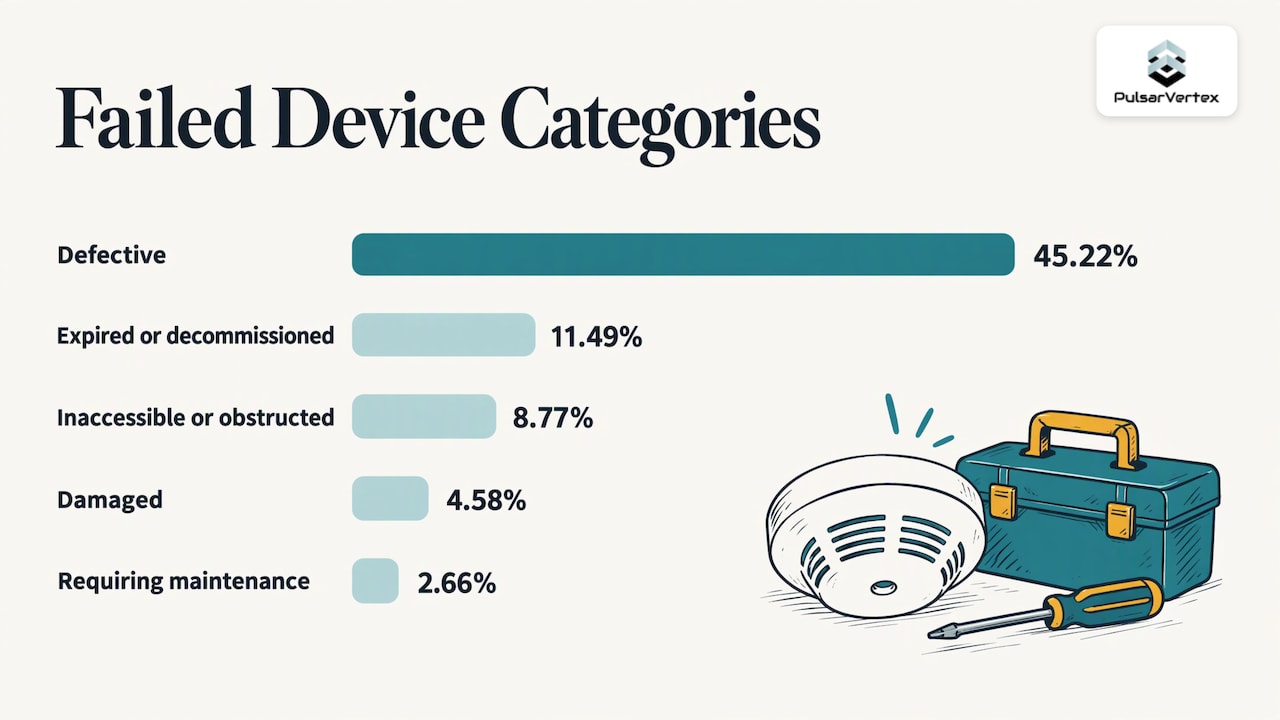
Faults are not rare edge cases. BuildingReports’ 2021 benchmark report analysed failed fire alarm devices and found that 45.22% were categorised as defective, 11.49% as expired or decommissioned (with expired batteries a significant share), 8.77% as inaccessible or obstructed, 4.58% as damaged and 2.66% as requiring maintenance. In other words, many failures are visible, preventable problems: obstructed devices, expired parts and damage.
Age matters too. A peer-reviewed study of 4,629 inspection reports, published in MDPI Buildings in November 2024, found that acoustic devices and detectors show significantly more defects after 10 years, especially in challenging environments, while cabling needs more attention in the early years of operation. That points to two different risks. New installations need careful commissioning and workmanship checks. Older ones need planned detector and sounder replacement.
Faults and false alarms are linked
A neglected system does not only go quiet. It can also cry wolf. The Seattle Fire Department reports in its preventable alarms memo that it responds to over 7,000 false or preventable fire alarms every year, roughly one in three fire calls, many tied to poor system maintenance. The same document explains that these calls take engines out of service for real emergencies, which is why Seattle can issue citations to encourage maintenance and necessary modification of alarm systems.
For a business, the practical lesson is that unresolved faults and repeated false alarms are both signs of a system that needs attention. In many US jurisdictions repeated unwanted alarms can bring fines, so check your local fire marshal’s rules.
How to investigate a fault safely
Work through this order every time.
- Look for fire first. Before treating anything as a fault, check for smoke, heat, the smell of burning or visible flame near the affected zone. If you find any sign of fire, activate the alarm, evacuate and call 911.
- Read the panel. Write down the exact display wording, the zone or device address, the time, and whether the message is trouble, supervisory or alarm. A photo of the screen helps your technician.
- Note what changed. Recent contractor work, a roof leak, a power cut, a storm, a new tenant fit-out or a battery that was due for replacement all give the technician a head start.
- Check the obvious. Confirm the panel’s circuit breaker is on. Confirm no detector has been visibly removed or covered.
- Do not disable devices to stop the noise. Silencing the buzzer acknowledges the signal but leaves the fault in place. If your fire watch or impairment procedures apply, follow them while the system is down.
- Call a qualified technician. Provide the panel make and model, the display text and what changed.
If the alarm appears to sound for no reason, treat it as real until the area has been checked. Look at the panel to identify the device that activated, go to that location, and look for signs of fire. Reset the system only once the cause is known.
What you can handle and what you should not
| Situation | Reasonable in-house action | Call a technician |
|---|---|---|
| AC power loss | Check and reset the breaker feeding the panel | If the message persists or recurs |
| Battery fault | Record the message and its date | Always, for testing and replacement |
| Ground fault | Record location and recent changes | Always |
| Open or short circuit | Check for removed or damaged devices | Always |
| Dirty or false-alarming detector | Report which device and what was happening nearby | For cleaning, testing or replacement |
| Communication fault | Check whether the phone or network line is down | Always, and tell your monitoring company |
Fire alarm work is specialist work. A general electrician is not automatically familiar with addressable loops, panel programming or the code requirements for testing after repairs. Check what licensing and certification your state or local authority requires for anyone who repairs or alters your system.
Preventing repeat faults
Most recurring faults are not mysteries. They come from deferred inspection, ageing parts and building changes that nobody told the fire alarm provider about.
Follow a documented inspection and testing schedule
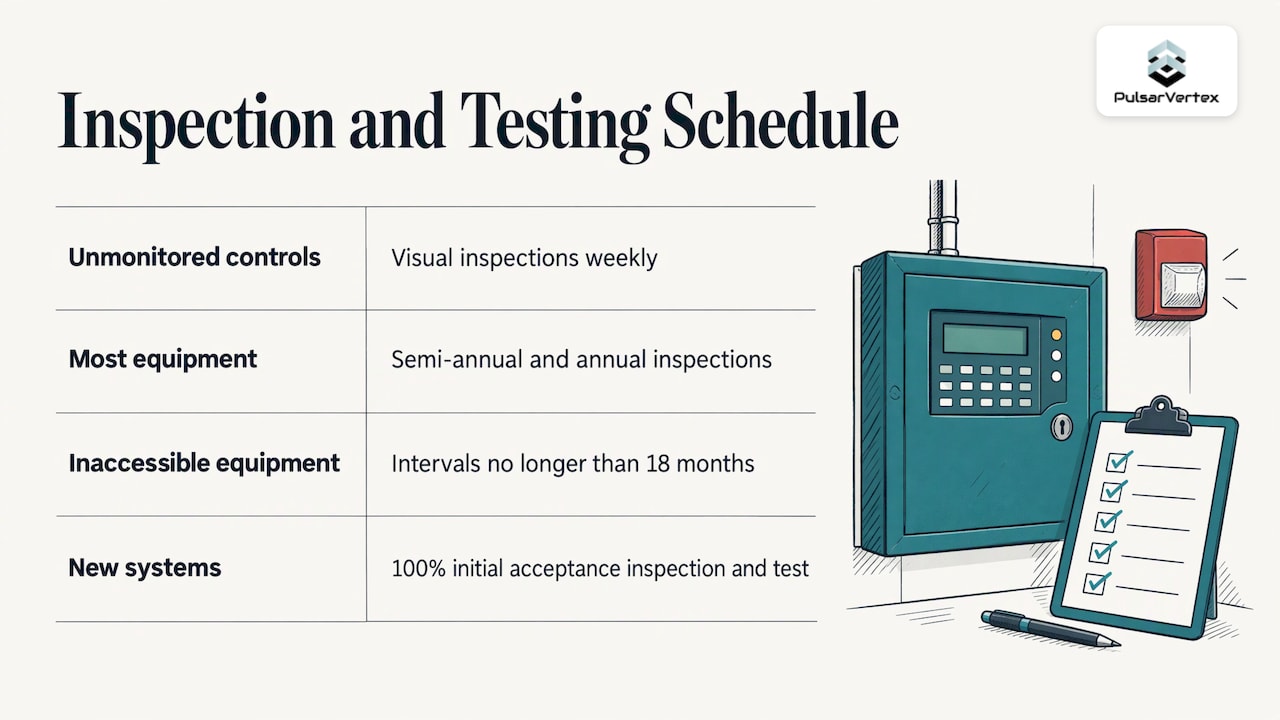
NFPA 72 sets the baseline in the US. Chapter 14 of the 2022 edition, summarised in this NFPA 72 chapter 14 training material, calls for visual inspections ranging from weekly for unmonitored control equipment to semi-annual and annual for most equipment, with extended intervals of no more than 18 months where equipment is inaccessible for safety reasons. A new system requires a 100% initial acceptance inspection and test. Your local jurisdiction may adopt a different edition or add its own requirements, so confirm with your authority having jurisdiction and your insurer.
Keep records
A logbook or digital record of every fault, test, battery change and false alarm lets a technician spot patterns. Three ground faults in the same stairwell in six months is a diagnosis waiting to happen.
Protect the system during building work
Dust is the enemy of smoke detectors. Before drilling, sanding or demolition, ask your fire alarm provider how to protect or temporarily isolate affected areas, and make sure everything is restored afterwards. Never leave detectors bagged or covered longer than necessary.
Replace on a plan, not on failure
Given the age-related defect pattern in the MDPI research, build detector, sounder and battery replacement into your capital budget rather than waiting for them to fail. Harsh environments such as kitchens, workshops, farms and coastal sites wear equipment faster, so they warrant closer attention.
Keep the system documented and current
When you change room layouts, add partitions or change a building’s use, tell your provider. Detector coverage that was right on day one can quietly stop being right.
Our perspective on fire alarm faults
Fire alarm faults rarely arrive without warning. In our experience, the panel has usually been trying to tell someone for weeks, and the message was silenced, logged and forgotten. That is why we treat every trouble signal as a coverage question: which part of the building can no longer report a fire, and for how long?
Pulsar Vertex Fire & Security Innovations designs fire alarm systems around the building and the people in it, from conventional and addressable systems to AOV and smoke ventilation. We believe a well-planned installation prevents many faults before they start, and that regular maintenance by people who know your system keeps them from returning. Our approach is built on expertise from planning to execution and a commitment to compliance and proactive service.
If your building mixes fire, security and networks, an integrated approach pays off. One team that understands cabling, detection, access control and alarm signalling finds the cause faster and avoids fixing one system at the expense of another.
Pulsar Vertex
Get faults fixed and stop them returning
Pulsar Vertex USA installs and maintains commercial fire alarm systems, including addressable and conventional systems, and offers fire safety training and consultancy. Our maintenance and repair service runs 24/7, so a fault does not have to wait for Monday.
See our commercial fire alarm installation and maintenance services, or read how our fire alarm service and emergency repair support works. If your site also needs door entry, CCTV or perimeter protection alongside fire detection, we can plan those together.
Questions people ask about fire alarm faults
How do I fix a fire alarm that goes off for no reason?
First check the panel to see which device activated, then inspect that area for smoke, heat or burning smells. If there are signs of fire, evacuate and call 911. If not, look for causes such as steam, cooking fumes, dust, insects or recent construction work, and have a technician clean, test or replace the device. Repeated unexplained alarms mean the system needs a service visit.
What is a comm fault on a fire panel?
A communication fault means the panel cannot properly talk to something it depends on. That might be the central monitoring station, or devices on a loop. The most serious case is a lost link to the monitoring company, because no one outside the building will be notified of a fire. Check whether the phone, cellular or network line is down and call your fire alarm provider promptly.
Can I silence a trouble signal and wait until morning?
Silencing the buzzer is normal procedure, but it does not repair the fault, and the affected devices may still be out of service. Report it to your service provider the same day. If a significant part of the system is impaired, follow your building’s impairment or fire watch procedures and check what your local fire code requires you to report.
How often should a commercial fire alarm be inspected?
NFPA 72 sets intervals that vary by equipment type, from weekly visual checks on some unmonitored control equipment up to semi-annual and annual inspections for most other items. Your jurisdiction and insurer may require more. A service provider can build a schedule that fits your system and local rules.
Sources
- NFPA fire alarm control unit fact sheet
- BuildingReports 2021 Fire & Life Safety Inspection Benchmark Report
- Defect Trends in Fire Alarm Systems, MDPI Buildings, 2024
- Seattle Fire Department, Preventable Fire Alarms memo
- NFPA 72 Chapter 14 training material
Is your panel showing a fault right now? Contact Pulsar Vertex USA through our fire alarm services page to book a repair visit or a maintenance review.