Utility-scale solar sites cover large areas, and the security cameras protecting gates, inverter areas and equipment yards may sit far from the operations building. Fiber-optic links can carry video and network traffic across those distances, but the cable itself is only one part of a dependable design. Route choices, cabinets, power, environmental protection and documentation determine how easy the system is to maintain when a link fails.
This guide is for US solar project owners, EPC teams and facility operators planning fiber-optic backhaul for CCTV and related security devices. It focuses on practical design questions to resolve before trenching, conduit work or commissioning begins.
Start with the security use case and site map
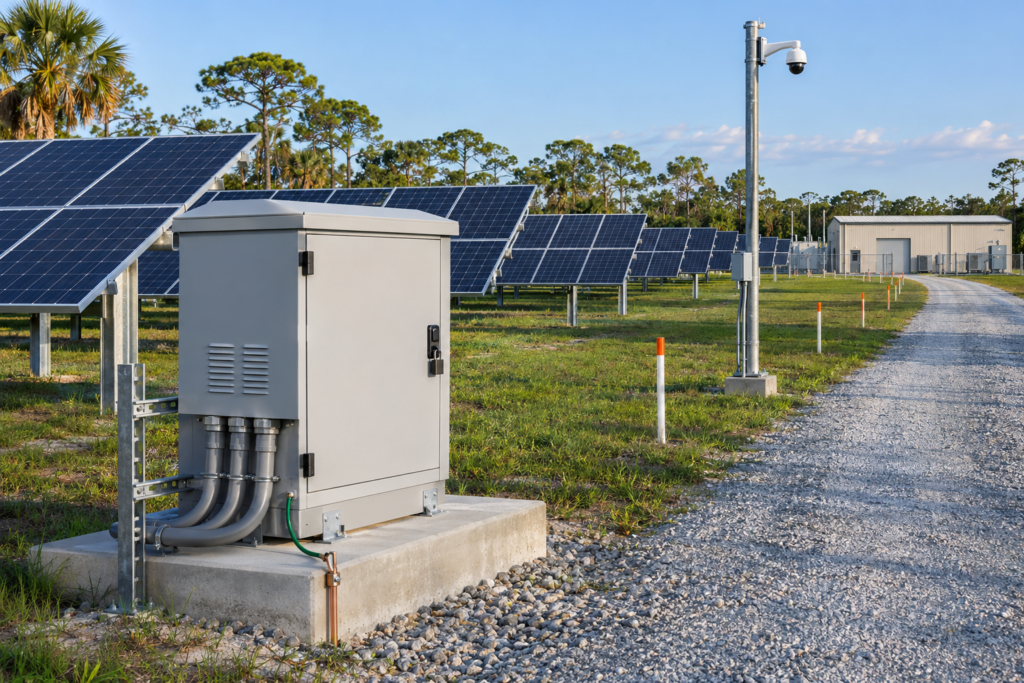
Mark every camera group, gate, security cabinet, operations building and network handoff on the current civil plan. For each location, record the devices to be served, expected video quality, whether analytics or intercom traffic is involved, and who needs access to the feed. This prevents the fiber layout from being based only on convenient trench paths.
Separate security transport requirements from plant monitoring and control requirements. Solar facilities may include inverter, SCADA, utility and corporate IT networks with different owners and risk profiles. The US Department of Energy’s Solar Cybersecurity overview describes solar systems as connected energy resources with communications to grid and automation systems. Coordinate security network design with the project’s OT and IT stakeholders; do not bridge networks simply because a spare port is available.
Choose a topology that fits the site
A star layout brings separate fiber runs back to a central switch or distribution point. It can make individual branch faults easier to isolate, but may require more cable or longer home runs. A ring can provide an alternate path when supported by the switches and configured correctly, but its recovery behavior, loop prevention and failure modes need to be documented and tested. Some sites use a combination: resilient backbone between zones with simpler branches to local cabinets.
There is no universal best topology. Compare route length, trench access, future expansion, repair access, switching equipment, power availability and the consequence of losing a segment. Confirm that the selected switches support the required topology and failover features; do not assume that physically closing a loop automatically creates a resilient network.
Plan field cabinets as maintainable network points
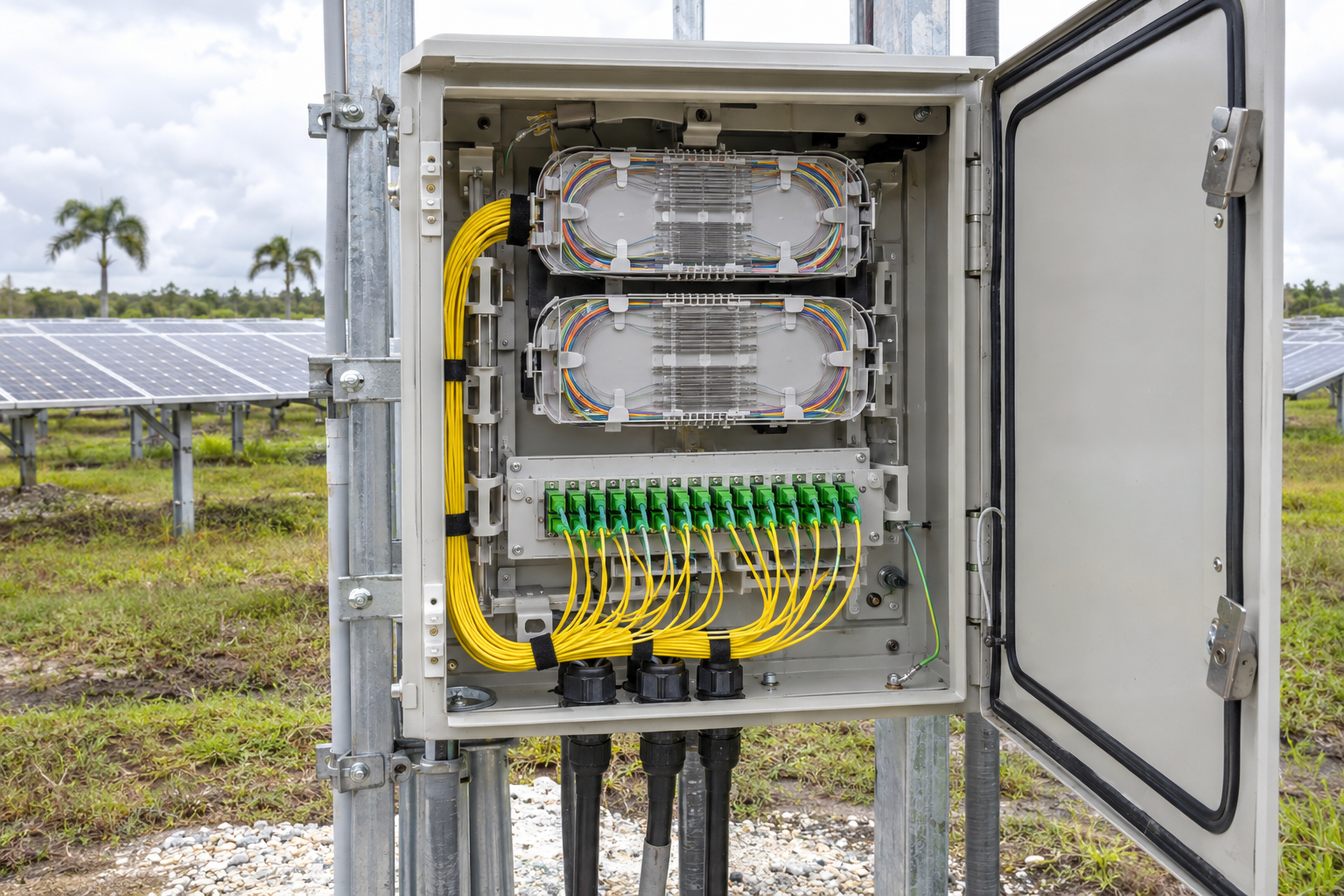
Remote cabinets need more than fiber termination. List the switches, media converters if required, power supplies, surge protection, grounding, backup power expectations and environmental controls. Select enclosures and cable entries appropriate to the location’s exposure to heat, moisture, dust, insects and physical access. Leave working space for technicians and a clear path to inspect connectors without disturbing unrelated circuits.
Agree who provides cabinet power and who is responsible for the enclosure, grounding, fiber termination and network configuration. In Florida, sun, rain and storm exposure deserve practical consideration, but avoid treating a weather-rated cabinet as a substitute for correct installation and maintenance.
Pulsar Vertex • Solar-site fiber networks
Keep remote camera links on a clear path.
Planning fiber backhaul for a solar farm? We can help map camera zones, field cabinets and network handoffs before the cable routes are set in concrete.
Prefer email? info@pulsarvertex.com
Protect the route and label both ends
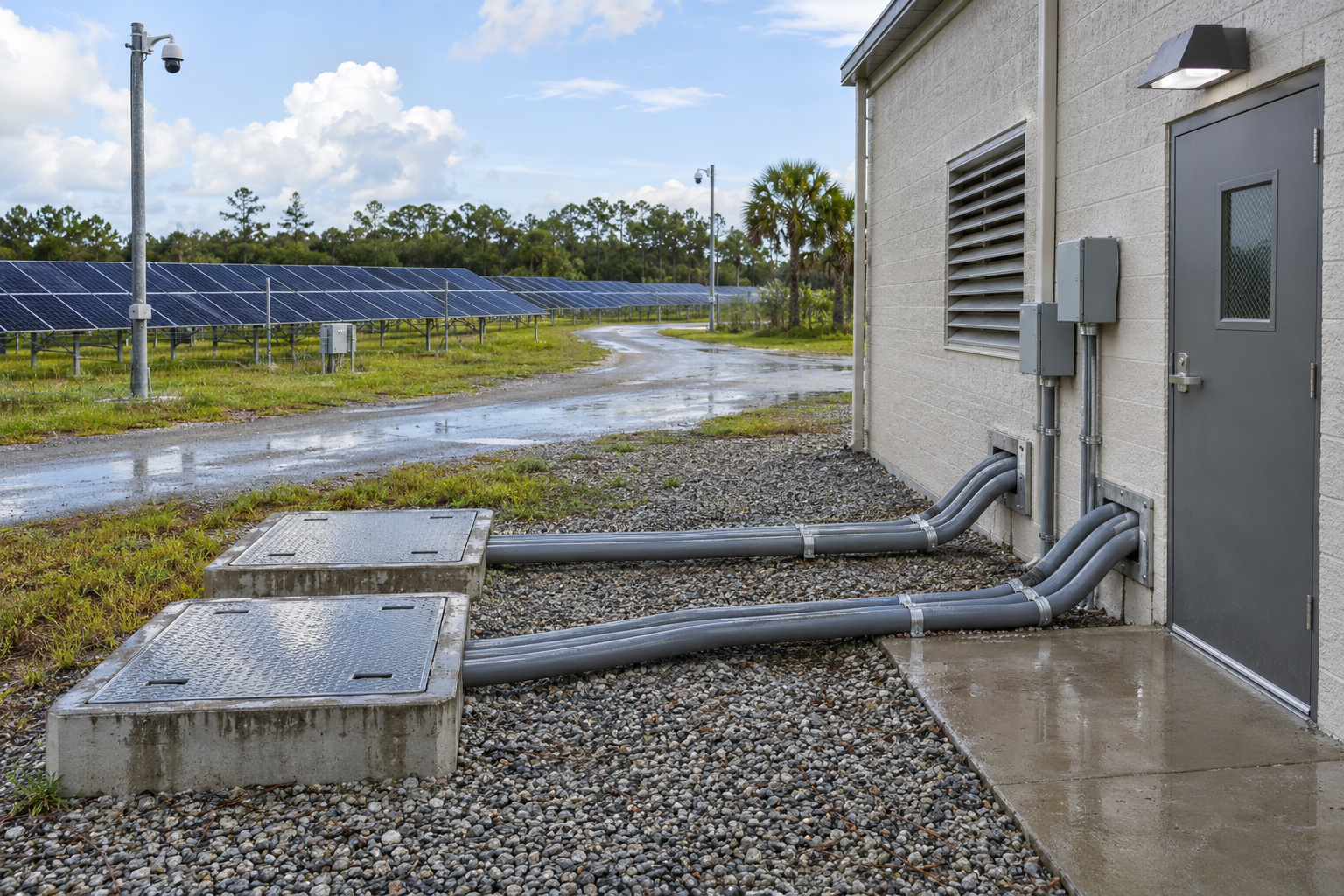
Coordinate the route with civil, electrical and fencing plans. Identify crossings, handholes, pull points and areas where later excavation is likely. Keep communications pathways identifiable and maintain separation practices specified by the project engineer and applicable codes. Use cable and connector types suited to the environment and installation method, and follow manufacturer bend-radius and pulling-tension limits.
Label each cable, fiber pair, enclosure and switch port consistently at both ends. Maintain a route drawing with cabinet IDs, splice or termination locations, strand assignments and spare capacity. CISA’s OT security resources emphasize asset visibility and network segmentation as practical parts of securing operational environments. Keep the security network’s inventory and approved connections current as the site changes.
Commission the link, not just the camera
- Inspect and test each installed fiber strand using the method specified by the project design and cable manufacturer.
- Verify switch port speed, duplex, VLAN assignment and link status at both ends.
- Confirm that camera streams remain stable during normal viewing and recording conditions.
- For a redundant path, test the designed failure scenario and confirm expected recovery with the network owner.
- Record test results, device configuration, cabinet power details, labels and as-built route drawings.
Also define what an outage looks like to operations staff: which cameras are affected, how the fault is reported, who owns first response and what temporary coverage is available. A labeled network map and a clear escalation path can save time when a remote cabinet or fiber segment needs attention.
Make future expansion part of today’s design
Solar sites evolve as equipment is added, access roads change and monitoring needs grow. Leave documented spare capacity where practical and make sure additions go through the same change control as the original installation. Review solar farm CCTV planning for remote asset protection alongside this network guide, and visit the Pulsar Vertex USA page for the Florida commercial and energy-site services we support.
Good fiber planning gives the security team a network it can understand, test and maintain. Map the purpose of each link, agree the network boundaries, plan serviceable cabinet locations and verify the design under realistic operating conditions before handover.