Mission-critical sites need more than a collection of cameras and card readers. Pulsar Vertex USA supports buyers seeking a data center security systems integrator and helps project teams plan integrated electronic security and low-voltage installation packages, from perimeter detection and credentialed entrances to video management, network infrastructure and commissioning.
Our US operations are based in Miami, with Florida as the priority service area. For projects elsewhere in the United States, delivery scope and any required state licensing or local installation partnerships are established before a proposal is issued.
Security systems for data center campuses
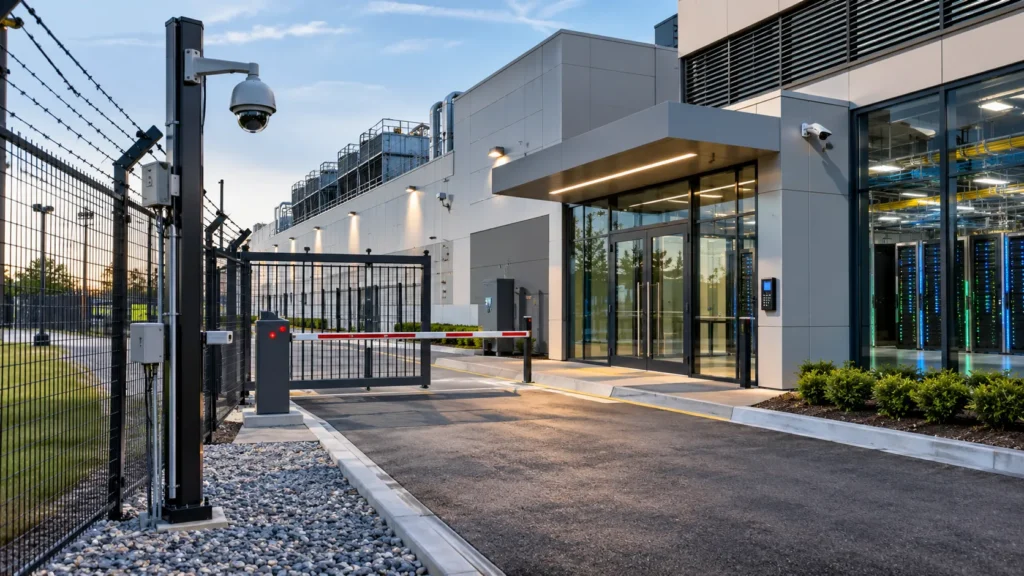
We assess each zone according to its risk, operational requirements and allowed personnel: property boundary, vehicle access, visitor lobby, security vestibules, mechanical rooms, carrier meet-me rooms, white space, tenant cages and individual racks. Systems can be designed to exchange actionable events without forcing every component onto a single vendor.
- High-security access control: smart credentials, PIN, card + biometric, anti-passback, occupancy rules and detailed audit trails.
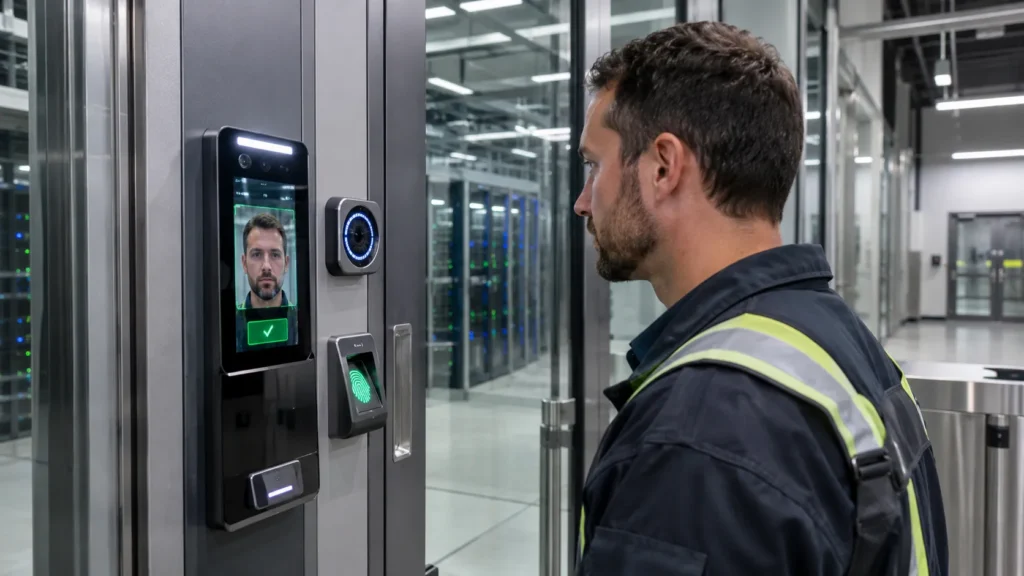
- Biometrics: facial, fingerprint or iris verification where suitable, with presentation-attack detection, non-biometric alternatives and data-protection planning.
- Interlocked vestibules: anti-tailgating and two-door controlled entry, while preserving code-compliant emergency egress.
- Video and perimeter: fixed and PTZ CCTV, thermal imaging, radar, fence sensors, event verification and VMS.
- Vehicle and visitor processing: gates, LPR, visitor credential expiry, escort workflows and arrival records.
- Rack and cage controls: monitored electronic locks, tenant segregation and access reporting.
- Communications infrastructure: Cat6A, optical fiber, PoE, switching, UPS-supported security equipment and tested routes.
Biometric access and dual verification
Sensitive spaces may require two authentication factors before a lock is released. A practical transaction pairs an issued credential with a face or fingerprint verification and checks the user’s authorization for that location and time. Dual verification does not necessarily mean two people: two-factor authentication verifies one person using different factors, while two-person authorization requires separate approvals by two authorized individuals.
A selected biometric system should be evaluated for spoof resistance, encrypted template storage, retention and deletion processes, enrollment quality, fallback procedures, accessibility and applicable state privacy obligations. Recognition of faces in security video is a distinct use case from consent-based biometric verification at an access door.
Perimeter protection, surveillance and event response
A perimeter risk study identifies likely approach routes, fence-line blind spots, lighting conditions, vehicle and pedestrian access points, and the distance available for response. Depending on the site, we can specify thermal imagers, fixed cameras, radar, fence disturbance detection and automated alarm-to-video workflows.
CCTV design focuses on usable evidential detail and operational decisions rather than camera count alone. A system may differentiate identification views at doors, contextual views of shared spaces and monitoring views along the boundary. Video retention, recording resilience, network segmentation and privacy masking should be engineered before procurement.
Structured cabling and resilient communications
Security controls depend on reliable, supportable networks. We plan copper and fiber routes, trays and containment, cabinet positions, field PoE budgets, environmental ratings, grounding and protection, labeling and as-built documentation. Link performance should be verified with appropriate copper certification and fiber loss/OTDR tests as required by the design and acceptance criteria.
High-availability sites may need redundant network paths, appropriately separated equipment locations and maintained power for security devices. UPS autonomy must be calculated from actual loads, with agreed failover behavior and monitoring—not assumed from a battery label.
How a data center security project is delivered
- Discovery and site assessment: review access zones, incident scenarios, uptime needs, tenant rules, drawings and operations constraints.
- Design: door schedules, camera fields of view, network topology, system interfaces, power and resilience schedules.
- Procurement and installation: approved equipment, coordinated cabling and controlled working in live facilities.
- Commissioning: reader events, door-held and forced-door alarms, biometric fallbacks, video association, failover and supervised alarm tests.
- Handover: operator training, acceptance reports, credential administration, warranties, as-built drawings and support arrangements.
Who we work with
Our integrated approach is intended for colocation operators, enterprise and edge data centers, developers, hyperscale project teams, general contractors, MEP contractors, security directors, IT managers and consultants who need clear interfaces between electronic security systems and network infrastructure.
Standards and life-safety considerations
Specifications can be reviewed against relevant project requirements including ANSI/TIA-942-C for data center infrastructure, applicable structured cabling standards and NIST SP 800-53 physical protection controls. For digital identity, NIST SP 800-63B-4 provides relevant biometric guidance. UL 294 equipment listing, the adopted fire and building code, AHJ decisions and local licensing requirements also matter to the final design.
References to standards describe design considerations, not a claim that Pulsar Vertex, a device or a particular project is independently certified. Emergency release, accessibility, fire interfaces and the required safe egress strategy must be resolved with the authority having jurisdiction.
Planning a data center security tender?
We can review your request for proposal, facility location, access-control door schedule, security coverage plan, known CCTV/VMS platforms, copper and fiber backbone requirements, construction program and commissioning criteria. This helps establish the integration boundaries and identify any specialist local licensing, life-safety or network engineering responsibilities before a price is discussed.
For a project enquiry: email the Pulsar Vertex team with the site’s state, project phase, required technology and desired response date. Share confidential security drawings only through an approved private channel.
Discuss a project in Florida or the wider USA
If you have a data center RFP, access-control schedule, security drawings or a planned retrofit, contact Pulsar Vertex with the facility location, desired scope, project phase and deadline. For immediate Florida enquiries, call +1 (305) 219-8726. We will confirm the appropriate delivery route and project requirements.
For additional technical detail, read our data center security systems and low-voltage installation guide, or explore our Florida commercial security services.