
Data center electronic security systems must protect critical infrastructure at every boundary—from the campus fence and loading bay to the last locked server cabinet. Security and low-voltage infrastructure are therefore part of the facility’s availability, operational resilience and customer trust, not simply a facilities add-on.
This guide explains how US data center operators, developers, consultants, general contractors and security directors can specify integrated data center security systems installation, including high-assurance access control, biometrics, two-door security vestibules, AI-assisted CCTV, perimeter intrusion detection, rack-level controls, fiber optic networks and commissioning. It also explains the practical questions a contractor should answer before equipment is purchased.
Looking for an installer? Pulsar Vertex USA’s data center security and low-voltage service page covers project delivery and enquiries. The company is based in Miami and prioritizes Florida projects; projects in other states are considered subject to location-specific scope and licensing requirements.
1. Layered Data Center Electronic Security: From Perimeter to Rack
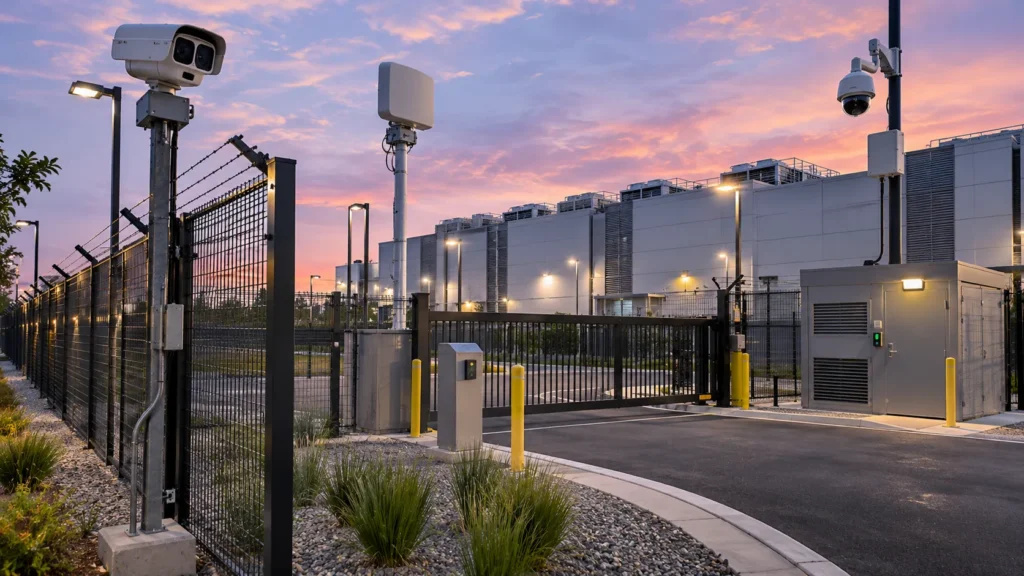
A data center’s electronic security architecture should use defense in depth. Perimeter detection and cameras help identify and verify an incident, a controlled door enforces an authorization decision and electronic rack locks segregate sensitive assets. No single layer should be treated as sufficient.
Start with a site risk assessment and a zone plan: public approach, fence line, vehicle control, staffed lobby, delivery and loading facilities, mechanical and electrical rooms, network meet-me room, data halls, tenant cages and racks. For each boundary, record who can enter, the method of authentication, permitted time windows, required escorts and how exceptional access is logged.
- Outside: thermal CCTV, radar or fence-line intrusion sensors, monitored vehicle entrances and cameras covering site approaches.
- Building envelope: monitored doors, protected windows or service openings, access permissions and controlled deliveries.
- Restricted zones: stronger authentication, anti-tailgating, timed visitor access and integrated alarms.
- Critical assets: tenant separation, rack locks, cabinet tamper monitoring and access audit trails.
The result should be a documented matrix of security zones and response procedures—not simply a bill of materials. Edge facilities may use fewer layers; hyperscale campuses and multi-tenant colocation sites may need more granular segregation and integration.
2. Biometric Access Control and Multifactor Verification
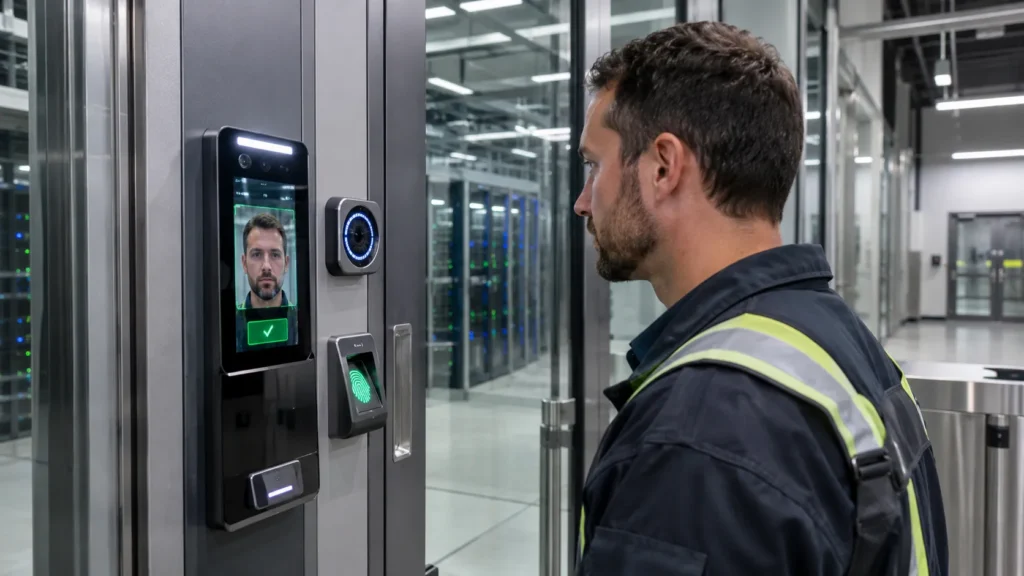
Restricted data center access-control systems may require credentials that provide greater assurance than a badge alone. Options include mobile credentials, encrypted smart cards, PIN pads, fingerprint readers, iris scanners and facial verification terminals. The right combination depends on the sensitivity of the zone, user population, accessibility requirements and incident response plan.
Example entry transaction: a staff member presents an issued credential; the access platform verifies identity and permission; the biometric device performs a fresh comparison with presentation-attack detection; the controller checks the door state and relevant occupancy or anti-passback conditions; and the lock releases when the configured rules are met. The event can be correlated with a nearby camera view and written to the access audit log.
Important distinction: a smart card plus a fingerprint constitutes two different authentication factors. A PIN plus a fingerprint is also two factors. Two facial scans, or two readers checking the same biometric, do not automatically create true multifactor authentication. Two-person authorization is a different policy: two separately authorized people must approve an operation or entry.
Biometric deployment should address false acceptance and false rejection performance, spoof resistance, enrollment and deletion, alternative non-biometric access, user notices, secure template handling and applicable state privacy laws. NIST’s current SP 800-63B-4 guidance explains why biometrics should not be treated as a stand-alone secret. A face recognized in a CCTV feed is not the same as a verified access-control identity.
3. Security Mantraps, Interlocked Doors and Anti-Tailgating
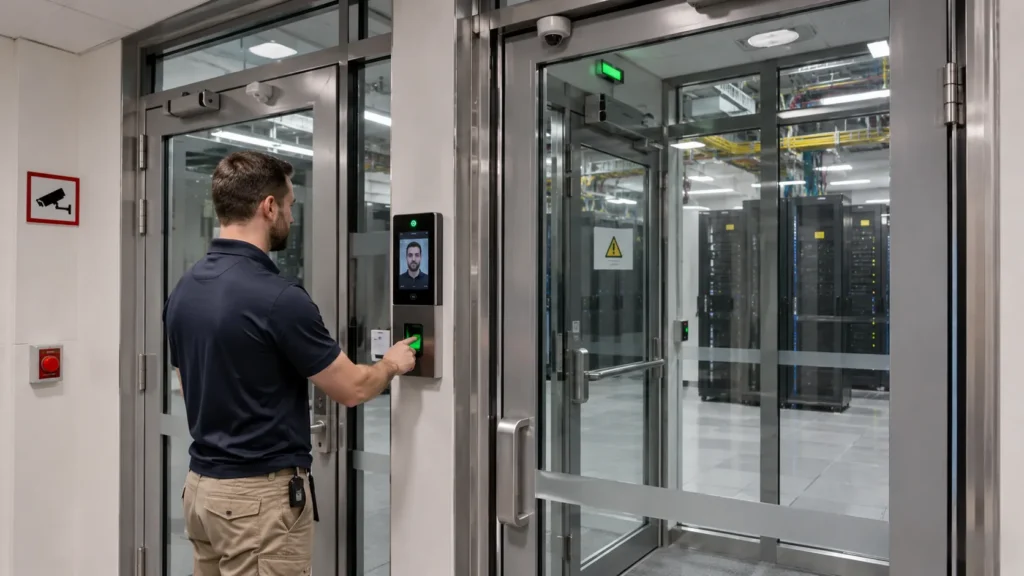
A security vestibule creates a second boundary between the ordinary circulation route and the critical room. In a typical interlocked two-door arrangement, a person authenticates at the first door, enters a small monitored space, waits for the first door to close and then authenticates or receives authorization for the inner door. Occupancy sensors, presence detection, door contacts and anti-passback rules may help identify tailgating and other abnormal sequences.
Design decisions include the number of people permitted in the vestibule, ADA accessibility, visitor and emergency procedures, the behavior of each lock during power loss, fire alarm and evacuation conditions, and how a person obtains assistance if an entry sequence fails.
Life safety is non-negotiable. A security interlock must not trap occupants during an emergency. The design, equipment listing, release methods and fire alarm interfaces must be reviewed against adopted building and fire codes and the authority having jurisdiction. High security does not justify obstructing required emergency egress.
4. Perimeter Detection: Thermal, Radar, Fence Sensors and Analytics
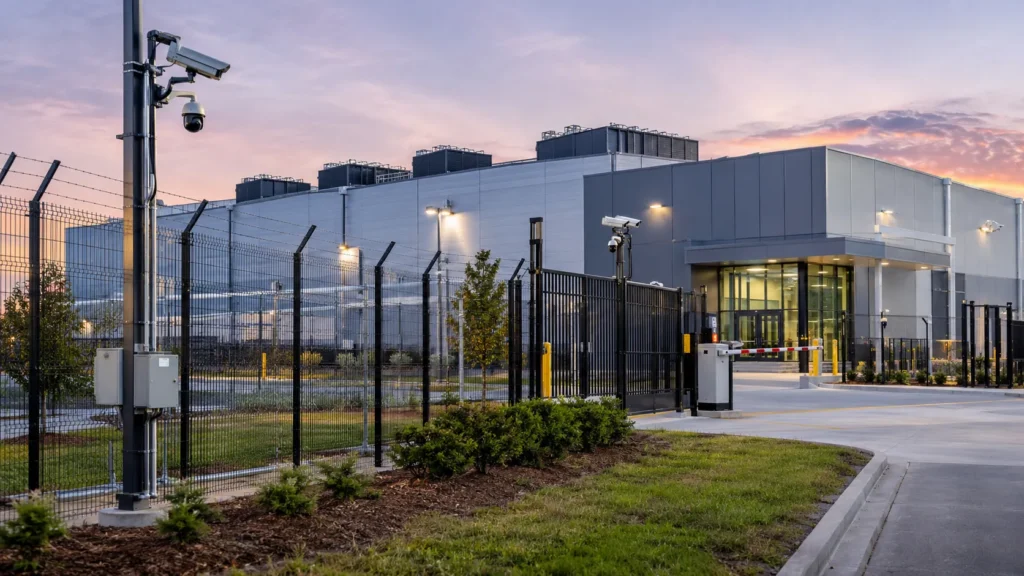
Data center perimeter intrusion detection should aim to detect activity early enough to verify and respond, while limiting nuisance alarms. A perimeter study considers fence geometry, vegetation, public roads, building setbacks, adjacent construction, lighting, drainage and weather. Camera placement and sensor overlap should be tested on a map rather than assumed from catalog range figures.
- Thermal cameras: useful for detecting temperature contrast across darker outdoor areas; they do not automatically identify a person.
- Radar: can detect and track moving targets over larger exterior zones, but mounting, clutter and site geometry affect performance.
- Fence-mounted sensing: detects mechanical events on selected fence types, subject to tuning for weather and legitimate activity.
- Video analytics: virtual tripwires, intrusion zones and loitering rules can help prioritize review; performance must be measured under site conditions.
- Video verification: sends a triggered camera view and location to a trained operator rather than relying on a sensor alarm alone.
Specify detection objectives, alarm response times, camera identification requirements, false-alarm tolerances, system maintenance and vegetation management. Integrate perimeter alarms with the VMS and monitoring platform, where supported.
5. Enterprise CCTV, Analytics and Video Management Systems
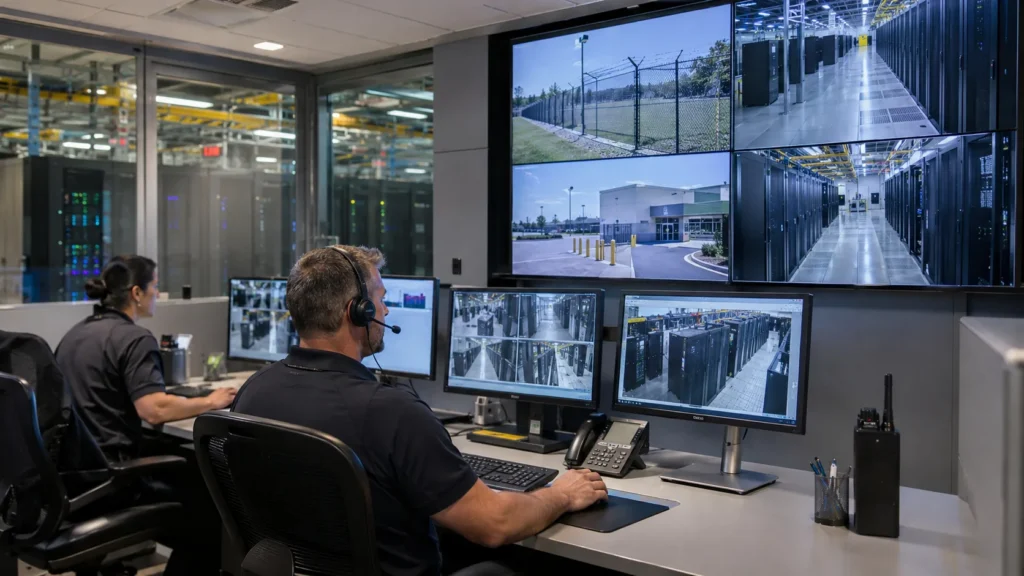
Data center CCTV should support incident investigation, live security response and operational accountability. Useful camera views include loading docks, the vehicle checkpoint, emergency exits, visitor reception, controlled door faces, sensitive corridors, tenant cages, building approaches and the perimeter. Each camera needs a defined purpose and realistic scene conditions.
An enterprise VMS can centralize live and recorded video, correlate door alarms with relevant cameras and provide role-based viewing permissions. Optional AI-assisted analytics can flag crossing of restricted boundaries, abandoned objects or unusual motion, but require supervised validation and human review. Avoid describing analytics as a guaranteed prevention mechanism.
Video architecture should address recording uptime, storage sizing, frame rates, low-light performance, retention rules, export procedures, clock synchronization, privacy masking and cybersecurity updates. Procurement should also consider whether the equipment meets customer supply-chain requirements, such as applicable US federal procurement restrictions.
6. Visitor Screening, Vehicle Access and License Plate Recognition
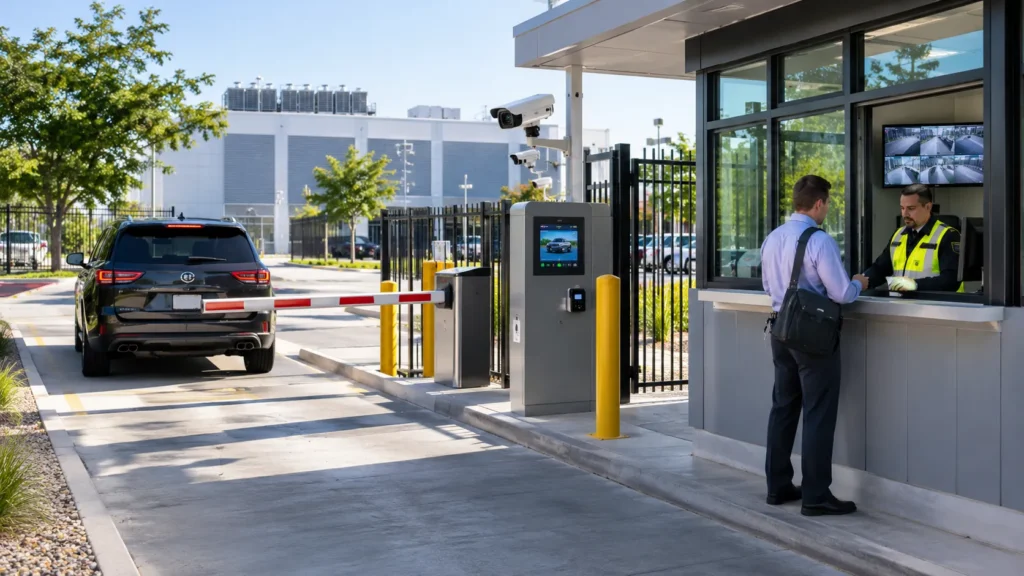
Employees, subcontractors, vendors and customers do not require identical access. Visitor workflows should capture the purpose of the visit, sponsor, time window, identity checks, escorted areas and exit confirmation. Temporary credentials need automatic expiry, and account termination should revoke access promptly.
At vehicle entrances, an LPR system may match a plate against an approved list and pass an event to the gate control platform. Plate recognition should be treated as one input to the access decision rather than proof of driver identity. Site owners may require a guard, secondary credential, vehicle occupancy check or visitor approval before raising a barrier.
Design the camera angle, shutter speed, infrared illumination, plate distance and lane geometry for the actual approach. Exception handling matters: rental vehicles, unreadable plates, deliveries, emergency vehicles and connectivity failures must have documented procedures. Avoid storing vehicle or visitor data longer than policy and applicable law permit.
7. Rack-Level Access Control and Tenant Cage Protection

Securing the data hall door is only the first step for a colocation or multi-tenant facility. Tenants and privileged technicians may be allowed inside the same room while access to individual cabinets remains restricted. Electronic cabinet handles, monitored rack locks and cage doors can introduce a further authorization boundary.
Rack-level controls may use issued credentials, networked controllers or local electronic locks. Specify the expected audit granularity, fail-state, battery service, compatibility with cabinet geometry, cable management, lock status sensing and the ability to reconcile an access event with a CCTV view. Mechanical override needs controlled key storage and use records.
A rack audit trail is particularly useful when several organizations share infrastructure. It should record the credential or operator, time and relevant cabinet without exposing unnecessary personal information. Do not infer that a rack is secure simply because an electronic handle is fitted; door construction, cage integrity and maintenance procedures matter.
8. Data Center Fiber Optics, Cat6A and Structured Cabling
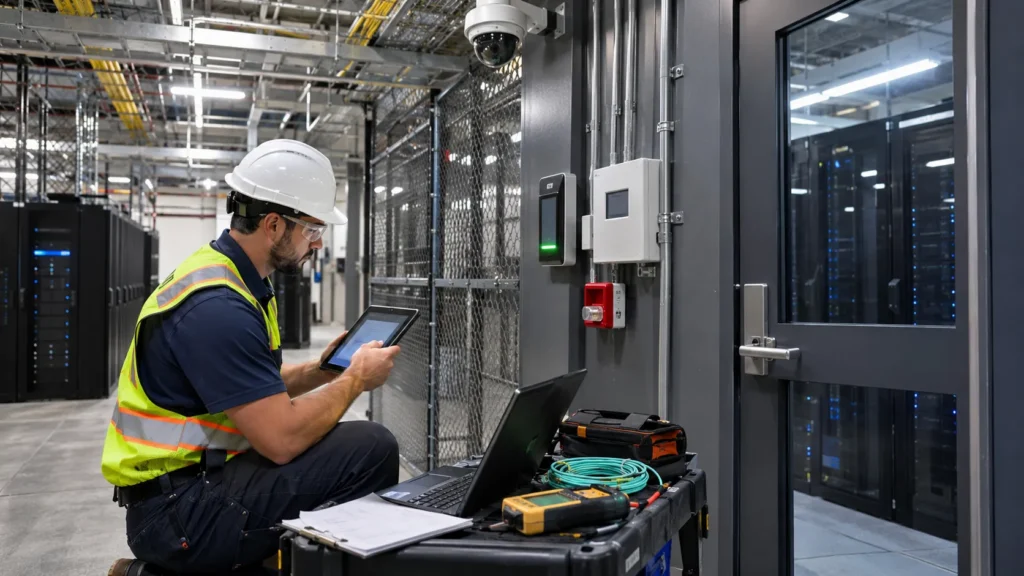
Low-voltage cabling is the communications foundation for IP cameras, access control panels, intercoms, security sensors, VMS workstations and management servers. A contractor should coordinate routes with the facility’s telecommunications architecture, power pathways, mechanical services and required separation between redundant systems.
Copper: select the appropriate cable class—often Cat6A for new performance-sensitive permanent links—along with pathway capacity, environmental ratings, allowable link lengths, PoE heating considerations and termination practices. Fiber: plan the required single-mode or multimode media, cable counts, backbone redundancy, patch fields and splice access. Consider future expansion and physically diverse routes.
Acceptance should include labeling, patch schedules, copper certification, optical loss measurements and OTDR testing when specified. Meet-me rooms and tenant demarcations need clear ownership boundaries. See TIA’s cabling standards information for relevant TIA-568, TIA-569, TIA-606 and TIA-607 families; project specifications determine which editions and clauses apply.
9. Intrusion Alarms, Event Correlation and Security Monitoring
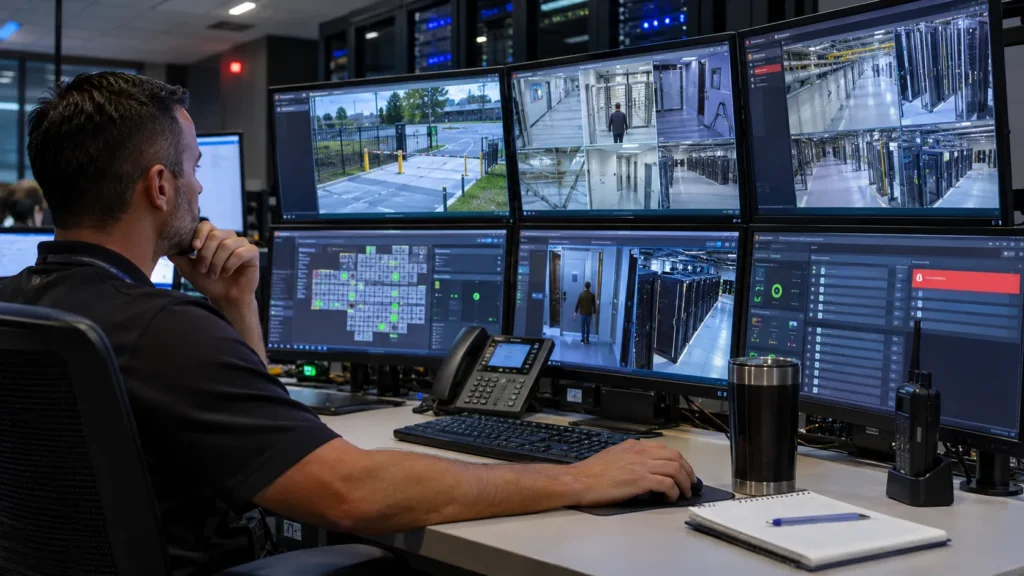
A useful security event should contain enough information to support a decision. For example, a forced-door event can identify the door, timestamp, controller status, related camera and escalation procedure. A fence alarm can identify the affected zone and open its video feed for operator verification.
Prioritize events by criticality and test what operators actually see. Door-held warnings, lock tamper, cabinet opening, controller offline, UPS on battery, video-loss and intrusion sensor alarms should be assigned consistent names and documented ownership. A monitoring contract should specify staffing, hours of coverage, verification steps, notification paths and who is responsible for dispatching responders.
Integrations may use supported SDKs, APIs or vendor interfaces, with change control and version compatibility testing. A unified dashboard is valuable only if it provides trustworthy information during faults, network interruption and system maintenance.
10. Resilience, Redundant Power and Cybersecurity
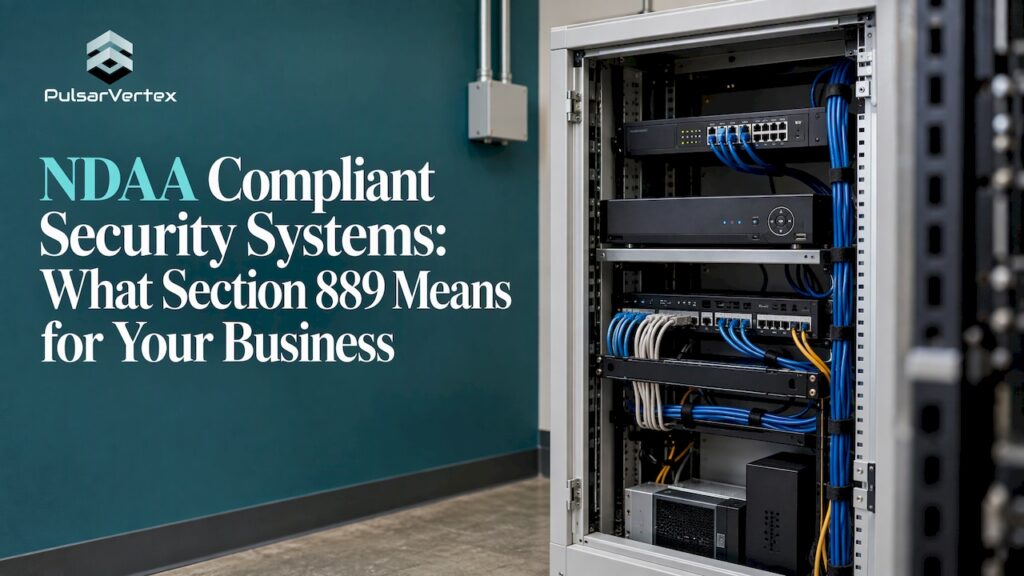
A data center security design must be resilient without creating a single new point of failure. Consider controller autonomy, failover for management servers, diverse field-network paths, switch and power redundancy, UPS endurance, environmental monitoring and recovery procedures. Specify what continues to operate during a WAN outage or server loss; some door controllers can continue to enforce cached permissions locally, but the capability is vendor-specific.
Segment cameras, access controllers, visitor systems and management interfaces from general-purpose networks as required by the owner’s IT policies. Change default credentials, use individual administrator accounts and MFA, restrict remote vendor access, maintain firmware support and log changes to access rules.
Security and safety failure states must be designed separately. A camera going offline is not equivalent to a door losing power, and security requirements cannot supersede required emergency unlocking or safe evacuation. Resilience acceptance tests should include loss-of-power and loss-of-network scenarios, restoration and alarm reporting.
11. Installation, Commissioning, Compliance and Handover
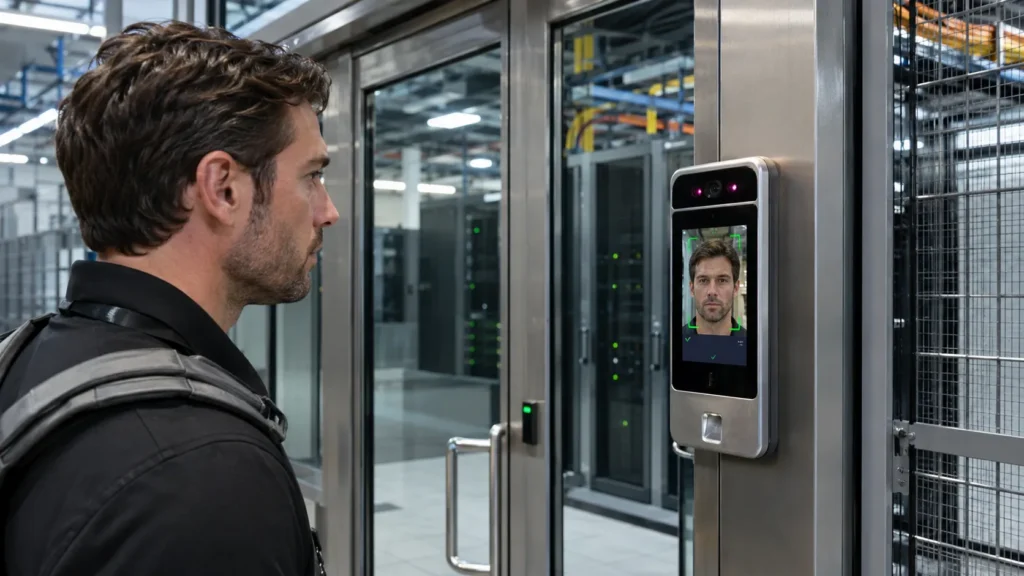
A credible data center security contractor should not treat installation as complete when every device powers on. Site access rules, outage windows, work permits, containment, labeling, working in active white space, cable protection and operational communications should be agreed in advance.
- Pre-installation: survey, drawings, equipment submittals, door hardware review, cable routes and testing method.
- Installation: disciplined cable management, approved mounting, device addressing and recorded configuration.
- Functional testing: granted and denied access, expired visitor credentials, anti-passback, biometric fallback, door-held/forced events, and alarm-to-video association.
- Failure testing: power loss, controller disconnect, network restoration, UPS alarm and the required emergency egress sequence.
- Handover: signed acceptance criteria, device inventory, passwords and account ownership transfer, training, warranties and as-built drawings.
Standards are supporting design inputs—not a substitute for project-specific code review, authority approvals and acceptance testing. Ask for evidence of applicable licensing, insurance, relevant project experience and qualified installation partners before award.
What a Data Center Security Contractor Proposal Should Include
A meaningful proposal should enable comparison of scope, risk and maintainability rather than just the lowest camera or reader price. We recommend asking bidders for the following deliverables:
- Security zoning and risk assumptions, including exclusions and operational responsibilities.
- Door and lock schedules with credential rules, emergency release, interlock sequences and accessibility requirements.
- CCTV coverage schedule with purpose and estimated image quality at each location.
- Physical cabling pathways, device network topology, PoE and power budgets, segregation and redundancy.
- System integration matrix covering VMS, ACS, intrusion, visitor management, LPR and monitoring.
- Procurement references, listing requirements, warranties, software licensing and data ownership.
- Factory/site acceptance criteria, testing reports, training, as-built drawings and ongoing maintenance.
If you are procuring an installation for a colocation site, specify tenant operational rules, escorted maintenance access, change control windows and who owns the credential lifecycle. For an existing live site, request a migration plan that avoids uncontrolled changes to production security.
Example security-zone specification matrix
A data center RFP should specify the purpose of each security layer and the evidence needed to accept the work. This example is a starting point—not a substitute for facility risk assessment or an AHJ-approved life-safety design.
| Security zone | Typical controls | Commissioning evidence |
|---|---|---|
| Campus boundary | Fence sensors, thermal CCTV, radar and alarm zoning | Recorded walk tests, alarm verification and coverage map |
| Vehicle checkpoint | Barrier, intercom, visitor workflow and optional LPR | Authorized, denied, escorted and emergency vehicle scenarios |
| Data-hall entrance | Credential plus approved second factor, monitored doors, optional interlock | Access failures, anti-tailgating, power-loss and compliant emergency-egress tests |
| Tenant cage or rack | Electronic lock, tenant-specific permission and door monitoring | Named audit event, expired authorization and service override test |
| Security network | Documented copper/fiber routes, segmentation, managed switching and UPS | Certification reports, outage and restoration tests, as-built records |
Include the project stage, construction drawings, expected door and camera count, perimeter length, optical-fiber routes, interface vendors, retained video duration and security monitoring responsibilities in the enquiry. These details permit a meaningful technical scoping conversation rather than a generic price per camera.
US Standards, Biometric Privacy and Code Considerations
ANSI/TIA-942-C is the current TIA data center telecommunications infrastructure standard and addresses broader physical-security and resilience considerations. NIST SP 800-53 includes physical access and monitoring controls that may be relevant to an owner’s compliance framework. NIST SP 800-63B-4 provides current guidance for biometric authentication and presentation-attack detection, although it is not a universal certification for physical access readers.
Depending on the project, UL 294-listed access equipment, locally adopted fire/building codes, NFPA provisions, ADA access, biometric privacy laws and other contractual standards may apply. These must be confirmed for the jurisdiction and facility. Mentioning a standard does not establish that a product or service is certified to it.
Data Center Security Installation: Frequently Asked Questions
Can a face-recognition system unlock a data center door on its own?
Technically, some devices support face-only operation, but high-security applications should generally use a stronger combination such as a protected credential plus biometric verification. The adopted policy must account for spoof resistance, privacy, fallback and human review. For regulated deployments, the relevant assurance framework may impose stricter requirements.
What is the difference between a mantrap and a two-person rule?
A mantrap is a physical controlled-entry vestibule, commonly with interlocked doors. A two-person rule is an authorization policy requiring two different authorized people. They can be combined, but one does not automatically provide the other.
Are thermal cameras enough to secure a data center perimeter?
No. Thermal cameras can help detect people or activity in challenging light, but alarm validation, coverage overlap, physical delay, monitoring and response procedures remain necessary.
Should a data center use Cat6A or fiber for security systems?
Both often have roles. Copper Ethernet is common for many endpoint devices within its design limits, while fiber is useful for backbone links, longer distances, electrical isolation and diverse routes. The exact architecture depends on distance, bandwidth, PoE requirements, redundancy and site standards.
Can security be upgraded without taking the facility offline?
Many components can be phased, but the migration plan must identify unavoidable service interruptions, temporary security measures, software integration risks and sign-off points. Work in production areas requires coordination with facility operations.
Does Pulsar Vertex install data center security systems across the entire USA?
Pulsar Vertex USA is based in Miami and prioritizes Florida. Projects outside Florida are assessed individually, with delivery subject to confirmed capabilities, project scope and applicable state/local licensing or appropriately licensed partners.
How much does data center security systems installation cost?
There is no dependable flat rate for a mission-critical installation. Costs depend on the number and type of doors, door hardware and required interlocks, biometric enrollment, camera coverage objectives, existing cabling and fiber routes, network resilience, site access restrictions, integration work, commissioning and monitoring. Ask for an itemized design-and-installation scope with clearly stated assumptions instead of comparing camera prices alone.
What should we share to request a technical quotation?
Start with your US site location and project phase. Useful supporting documents include campus or floor plans, door and camera schedules, perimeter drawings, equipment-room locations, known network standards, existing access-control or VMS brands, planned build milestones and RFP requirements. Sensitive plans should be shared through an approved secure channel, not publicly posted online.
Request a Data Center Security Project Assessment
Pulsar Vertex USA can discuss integrated data center electronic security and low-voltage projects, including access control, perimeter intrusion, CCTV, low-voltage communications and system commissioning. Share your facility location, project phase, security zones, drawings and required timeline via the existing enquiry route. Florida enquiries can also call +1 (305) 219-8726.
Photography is illustrative of representative configurations; it does not claim to depict a specific Pulsar Vertex client installation. Project requirements and legal compliance are established individually.
Related information: Pulsar Vertex USA commercial security, commercial access control, business CCTV and perimeter intrusion detection.