
A stolen tractor, cut fuel tank or damaged grain store can halt work long after the initial incident. Agricultural premises are often spread across multiple buildings, tracks and field entrances, with limited natural surveillance outside working hours. Effective security systems for agricultural sites need to protect valuable assets without creating more daily administration for already busy farm and estate teams.
The answer is rarely a single camera on a shed. It is a properly engineered combination of visible deterrence, early detection, controlled access and usable evidence, designed around how the site actually operates.
Start with the site, not the equipment
Agricultural security fails when equipment is selected before risks are understood. A dairy operation, arable farm, machinery yard, equestrian facility and grain storage site may all face theft and trespass, but their exposure, operating hours and critical assets are different.
A site assessment should identify where people, vehicles and equipment enter and leave; where valuable machinery, chemicals, fuel and livestock are kept; and which routes intruders are most likely to use. It should also consider legitimate access by staff, contractors, delivery drivers and seasonal workers. A gate that is locked overnight but left open for early feed deliveries needs a different solution from a controlled machinery compound.
Coverage must account for the realities of rural sites: long distances, poor lighting, uneven ground, dust, rain, vegetation growth and unreliable communications infrastructure. Cameras and detectors positioned for a clear view in winter can be obstructed by crops or foliage later in the year. This is why a design should be reviewed as an operational system, not treated as a one-off installation.

CCTV that provides evidence, not just footage
CCTV remains central to security systems for agricultural sites, but its value depends on image quality, placement and response. A wide-angle camera may show that a vehicle entered a yard, yet be unable to identify its registration or the individual involved. Critical points such as entrances, fuel stores, workshops, machinery sheds and loading areas need cameras selected and positioned for a specific purpose.

Commercial-grade IP CCTV can provide high-resolution footage, infrared night vision and remote viewing for authorised users. At key vehicle approaches, automatic number plate recognition can record registrations and create a clearer record of movements. Thermal cameras can be particularly effective on large or poorly lit perimeters because they detect heat rather than relying on visible light.

Remote access is useful, but it should not become a false sense of control. Someone still needs a defined process for alarms and suspicious activity. For higher-risk locations, monitored CCTV with video verification can help distinguish a genuine intrusion from movement caused by wildlife, weather or farm activity. That reduces unnecessary call-outs while allowing a rapid, proportionate response to verified incidents.
Camera coverage also requires careful consideration of privacy. Systems should be focused on legitimate security areas, with clear signage and appropriate data handling arrangements. Where staff accommodation, neighbouring property or public rights of way are nearby, the system design must respect those boundaries.
Perimeter detection gives earlier warning
By the time an intruder reaches a machinery shed, they may already have selected their target and started causing damage. Perimeter protection is designed to create time: time to verify an event, alert the right people and deter further entry.
The right approach depends on the boundary. A compact yard may benefit from monitored gates, fence-line detection and external detectors covering the approach to buildings. A larger estate or remote renewable-energy installation may require longer-range detection, thermal surveillance or strategically protected zones rather than attempting to cover every metre of fencing in the same way.
External intruder detection must be selected carefully. Agricultural environments contain wildlife, moving vegetation, changing temperatures and heavy weather. Poorly designed sensors generate repeated false alarms, leading users to ignore alerts or disable the system altogether. Commercial equipment, professional positioning and correct calibration are essential to reliable performance.

Visible deterrents still matter. Secure fencing, controlled gates, appropriate lighting and clearly displayed surveillance signs make opportunistic theft less attractive. However, lighting should support the camera system rather than wash out images or inconvenience nearby residents and road users.
Pulsar Vertex | NextGen corporate security.
Concerned about theft or trespass on your farm?
Get an engineered security assessment for machinery yards, fuel stores, buildings and perimeter boundaries. We’ll review access routes, coverage and alert response before specifying equipment.
Control who can enter the site
Keys are difficult to manage across farms and estates, particularly where contractors, temporary staff and multiple buildings are involved. A missing key may go unnoticed for months, and changing locks after staff changes can become expensive and disruptive.
Access control replaces uncertainty with an auditable record. Keypads, proximity fobs, mobile credentials, QR passes or biometric readers can grant access to specific gates, offices, workshops and stores at defined times. Permissions can be removed promptly when a contractor finishes work, without recovering a physical key first.
This is particularly valuable for high-risk areas such as chemical stores, fuel compounds, veterinary medicine cabinets and server or communications rooms. It also supports safer site management by showing who accessed a restricted area and when.
Access control is not always appropriate for every farm gate or field entrance. On sites with frequent vehicle movements and changing seasonal access, a simpler controlled-gate arrangement may be more practical. The objective is accountable access where it matters most, rather than adding friction to ordinary operations.

Protect fuel, machinery and critical buildings
Diesel theft remains a persistent concern because fuel can be removed quickly and resold easily. Fuel tanks should be treated as a priority asset, protected by lighting, camera coverage, physical barriers and intrusion detection where risk justifies it. The same principle applies to GPS equipment, tools, ATVs, trailers and high-value attachments stored in open or lightly secured areas.
Workshops and grain stores need layered protection. Door contacts, roller-shutter monitoring, internal intruder detection and CCTV can work together so an attempted entry is detected before an offender reaches valuable equipment. For isolated structures, communications resilience is equally important. A high-specification alarm is of limited use if it cannot signal an event when a primary connection fails.
For valuable plant and agricultural GPS receivers, start by securing the storage location and recording the route an offender would use to remove equipment. Cameras should deliver a useful view of the object and vehicle approach, while the intrusion system should raise an actionable alert rather than simply logging motion.
Fire protection should also be considered alongside security, especially in machinery buildings, storage areas and facilities with electrical equipment or combustible materials. A suitable fire alarm system, correctly designed and maintained, supports life safety, asset protection and operational continuity. In the UK, the design and maintenance approach should reflect the site’s fire risk assessment and applicable standards, including BS 5839 where relevant.
Build resilience into communications and power
Agricultural sites can present difficult connectivity conditions. Outbuildings may be too distant for conventional cabling, while mobile signals can vary across the property. A professional design assesses whether fibre, structured cabling, point-to-point wireless links, cellular backup or a combination of these is required.
Power resilience matters too. Cameras, access control panels and communications equipment should be protected against short interruptions where operationally necessary. For remote compounds, system health monitoring can identify offline devices, storage faults or communication failures before an incident exposes the weakness.
The cheapest installation often omits this underlying infrastructure. That may reduce the initial quote, but it can create recurring faults, unreliable recordings and costly remedial work later. Security performance depends as much on networks, power and maintenance as it does on cameras and detectors.
Maintenance keeps protection dependable
Mud on lenses, damaged cable routes, overgrown vegetation, drained backup batteries and altered building layouts all reduce security performance over time. Planned maintenance gives site managers confidence that recording, detection, signalling and access permissions remain fit for purpose.
Which security measures should an agricultural site prioritise?
No two rural properties need the same specification. A practical order of priorities starts with the entrances and the assets whose loss would cause the greatest operational disruption.
- Machinery yards and workshops: fixed IP cameras at approaches and roller shutters, reliable recording, monitored doors and good night-time identification.
- Fuel tanks and chemical compounds: robust physical containment, clear camera views of access points, suitable detection and tightly controlled authorisation.
- Equestrian and livestock facilities: surveillance around gates and stores without unnecessary coverage of staff accommodation or sensitive private areas.
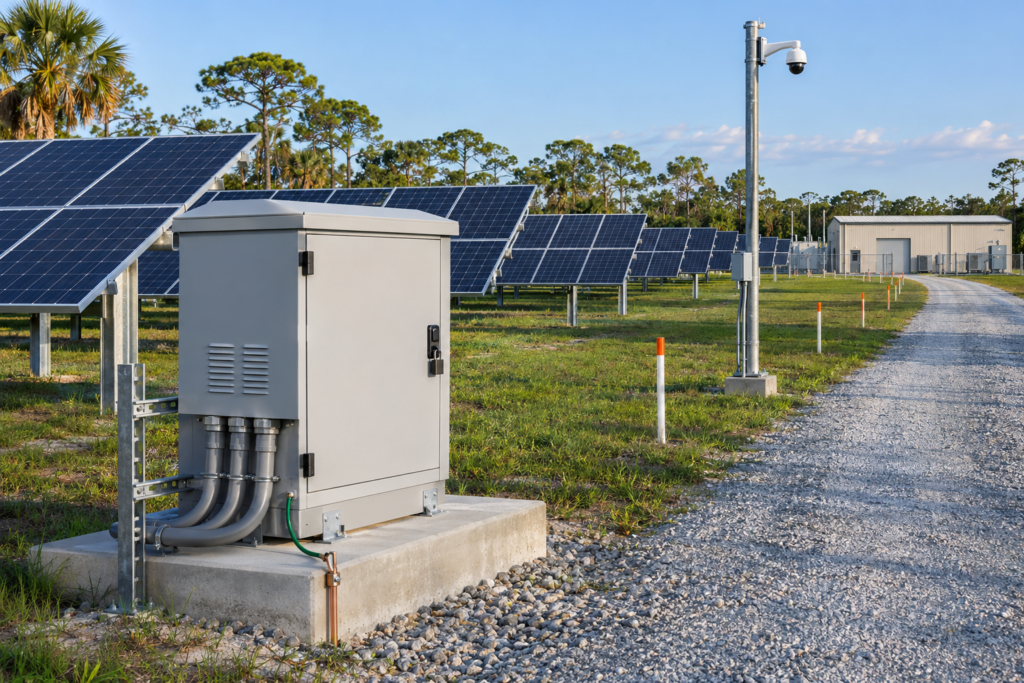
- Large estates and remote solar installations: risk-based perimeter zones, thermal or video analytics where appropriate, and resilient fibre, radio or cellular communications.
Frequently asked questions about farm security systems
Can farm CCTV work without reliable broadband?
Yes. On-site recording can continue without a constant internet connection, provided suitable local power and storage are available. Remote viewing and alarm transmission depend on the available backhaul, which may use 4G/5G, a point-to-point wireless link or fibre. The design should also specify what happens during an outage.
Are thermal cameras better than conventional CCTV for farms?
They serve different purposes. Thermal imaging can assist detection across unlit or long-range boundaries, while visible-light cameras are usually needed to capture identifying details. Sites with serious perimeter risks often benefit from both, with sensible rules to reduce wildlife-related false alerts.
How much does agricultural CCTV and perimeter security cost?
The cost depends on the number of protected zones, night-time identification requirements, distance between buildings, existing network and power infrastructure, storage, monitoring and maintenance. A site survey is the right basis for a meaningful quotation; a camera-only price does not reflect the full reliability of the system.
A maintenance visit should include more than a quick visual check. Engineers should test critical functions, inspect equipment condition, review event logs where appropriate and identify changes that affect coverage. Emergency repair support is equally important when a gate controller, recorder or alarm path fails unexpectedly.
Pulsar Vertex approaches agricultural protection as an integrated engineering task: assess the exposure, design for the site’s daily operation, install commercial-grade technology and maintain it for the long term. That approach is particularly relevant where a farm or estate also includes solar generation, battery storage, warehouses or other infrastructure requiring higher levels of perimeter resilience.
The most useful next step is to walk the site after dark and ask a direct question: if an unauthorised person entered tonight, where would they come in, what would they target, and who would know in time to act? The answers provide a far stronger starting point than a catalogue of security products.