
Your cameras record who enters a building. Could your security team find the right event faster? Properly specified facial recognition CCTV may help authorized operators review potential identity matches at selected entrances, reducing the effort of searching long video timelines. But not every AI camera can recognize faces—and an automated match is never conclusive proof of identity.
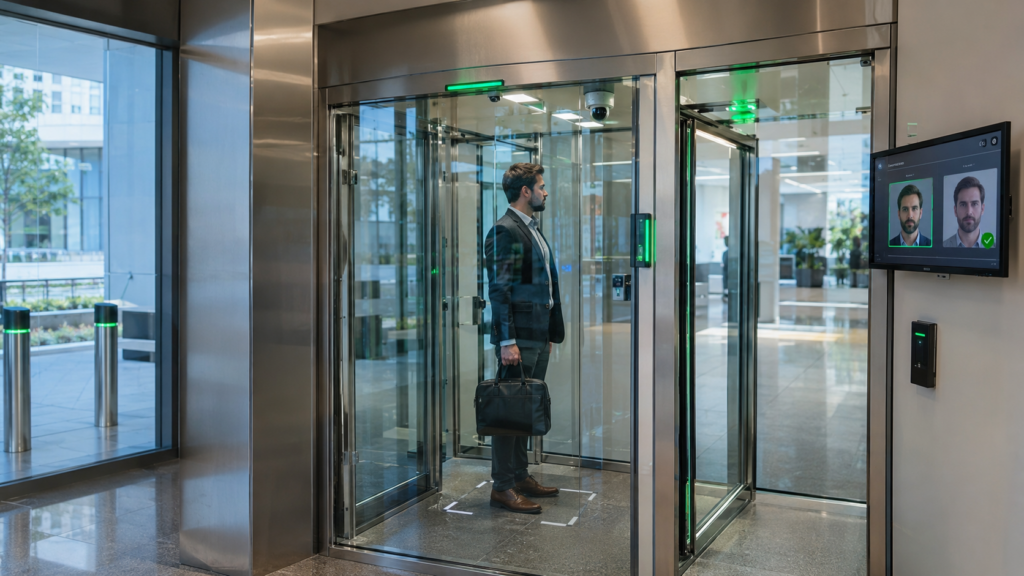
Illustrative workflow images, not screenshots from a tested facial-recognition deployment or evidence of a verified identity match.
At Pulsar Vertex USA, we design integrated commercial CCTV systems in Miami and across South Florida for facilities where conventional video, access control and intelligent alerts must work together. The objective is useful security intelligence—not automatic accusations or unverified promises of perfect recognition.
What is facial recognition CCTV—and what isn’t it?
Face detection finds the position of a face in a camera image. Face recognition compares a facial image with an enrolled reference image or gallery and calculates whether there may be a match. Face search can help authorized staff retrieve relevant footage more quickly after an incident. These functions are not interchangeable, and a camera advertised as ‘AI’ does not automatically support all three.
Some implementations perform matching at the edge (on the camera); others use a compatible NVR or dedicated analytics server. Performance depends on image quality, viewing angle, lighting, occlusions, reference-image quality and the system’s chosen matching thresholds. Even a high-confidence match is a candidate, not proof of identity or wrongdoing.
Five practical applications for South Florida businesses
1. Commercial buildings and controlled access
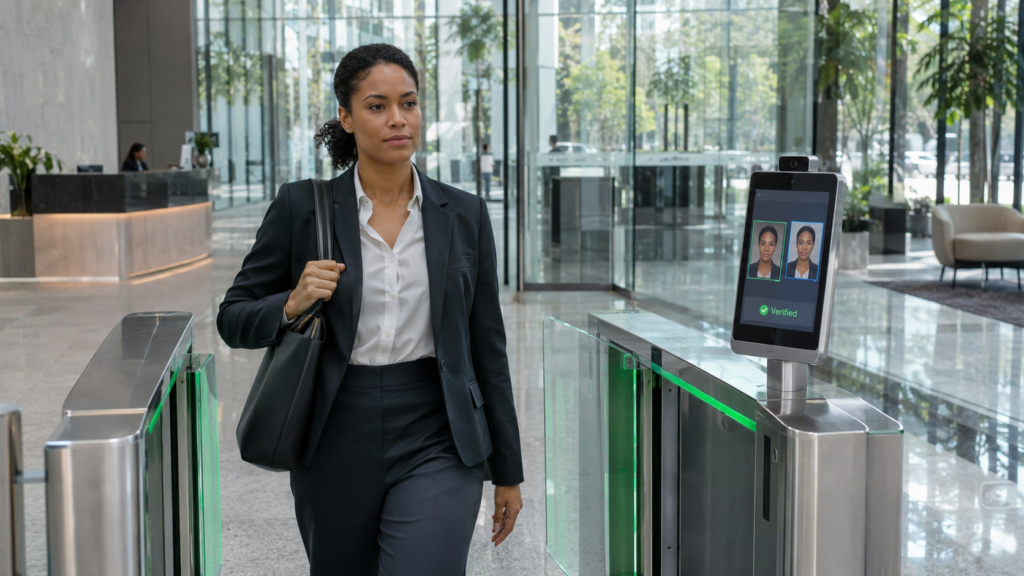
At suitable, restricted entrances, biometric verification can be considered as part of a carefully planned access workflow. Where an organization needs a less intrusive option, mobile credentials, cards, PINs or visitor intercoms may be more appropriate. A dependable access control integration should never assume that facial recognition alone is a sufficient authorization decision.
2. Warehouses and logistics centers
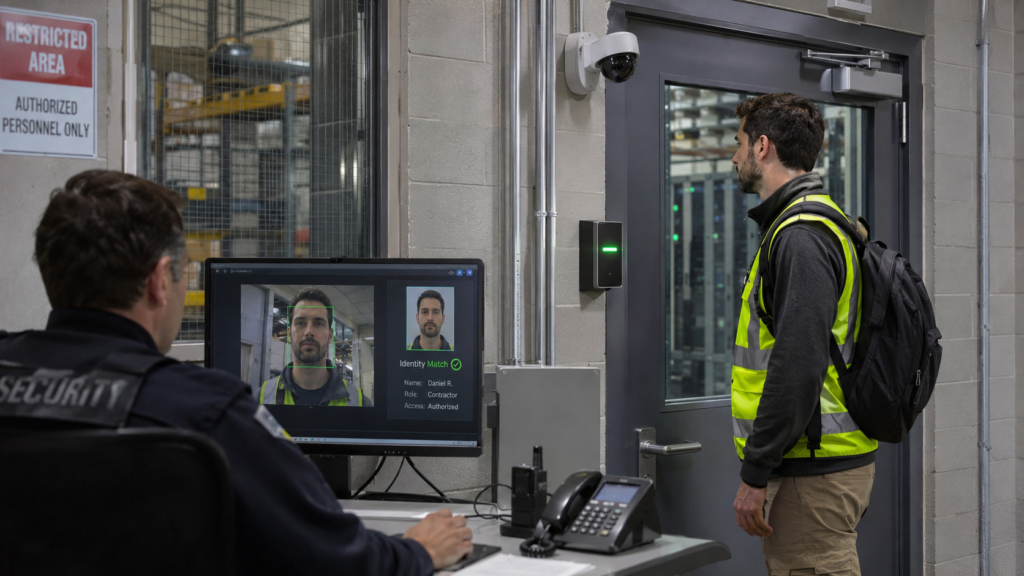
Distribution operators may need to investigate repeated after-hours access attempts, identify when a familiar authorized person appears in footage, or correlate events across gatehouses and loading areas. We typically start by mapping camera coverage, lighting, event search and warehouse CCTV infrastructure before deciding whether biometric functions add measurable value.
3. Retail premises and shopping centers
Retail operators sometimes ask about watchlist alerts for previously documented incidents. Such deployments demand particular care: an incorrect match could wrongly implicate a customer or employee. An alert should trigger an appropriate human review—not confrontation, exclusion, detention or adverse action based solely on algorithmic output.
4. Hotels, offices and mixed-use developments
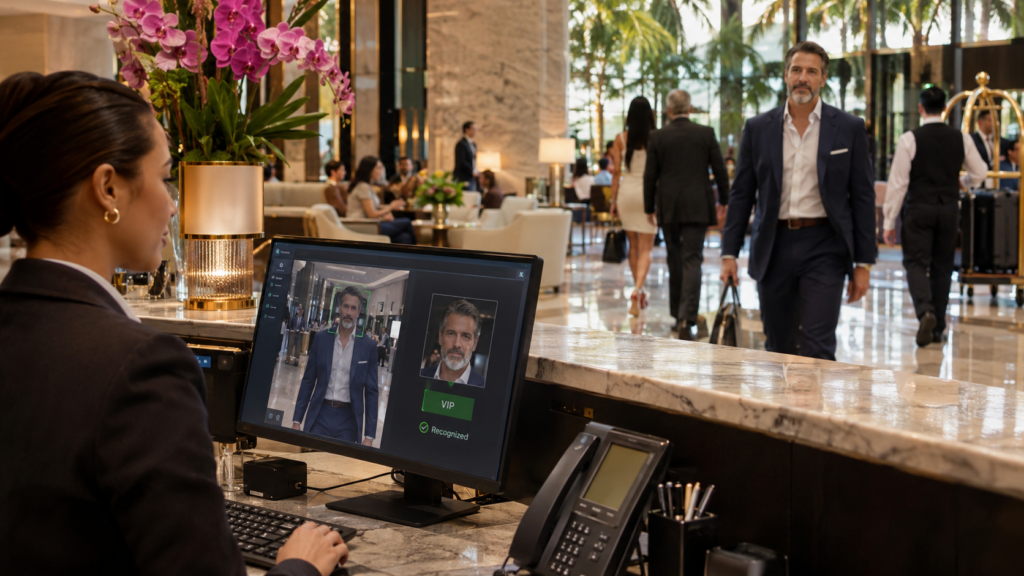
Managed access points, back-of-house corridors and visitor areas may benefit from coordinated CCTV and door-entry records. Whether identity matching is justified depends on the location, purpose, people affected and whether less intrusive controls achieve the same objective.
5. Multi-building property and parking operations
Facility managers frequently benefit first from cameras that capture useful evidence, timestamp synchronization, protected network connectivity, and incident notifications. For vehicle entry, license plate recognition is a separate capability from facial recognition. An integrated design can bring CCTV, intercom, gates and vehicle analytics into one review process without conflating the technologies.
What makes a reliable installation?
- Camera placement: realistic face-capture angles, appropriate lenses, controlled glare and suitable night-time lighting.
- Defined workflow: explicit purpose, carefully controlled reference lists, tested thresholds and clear operator escalation steps.
- Human verification: trained personnel independently reviewing candidate matches before action is taken.
- Cybersecurity: segmented networks, restricted administrator rights, encrypted transport where supported, software updates and audit logs.
- Retention and access policy: limited enrollment, clear deletion rules and documented access to footage and templates.
- Integration: correctly sized PoE networks, NVR or analytics server capacity, resilient storage, UPS and compatible access-control equipment.
Pulsar Vertex • NextGen corporate security
Get a site-specific CCTV and access control assessment.
Whether you need clearer footage, AI event search, door-entry integration or a carefully reviewed facial recognition workflow, our team can help specify the right solution for your facility.
Prefer email? info@pulsarvertex.com
Privacy, accuracy and responsible use
Facial templates can constitute sensitive biometric information. Before deploying an identity-matching system, businesses should assess the legal basis, applicable federal and state requirements, notice and consent where required, vendor data handling, employee and visitor rights, and whether biometric processing is necessary at all. Rules can vary by location and use case; a Florida installation is not automatically governed by every statute that mentions facial recognition.
The US Federal Trade Commission has highlighted serious problems caused by facial-recognition deployments without adequate safeguards, including false-positive matches. Test the proposed system under real site conditions, examine vendor accuracy evidence and potential differences in error rates across populations, restrict watchlists and ensure staff never treat an automated alert as an established fact.
Our recommendation: start with an operational and privacy assessment. Choose conventional video analytics, secure door credentials or other less intrusive controls wherever they achieve the same security outcome. Only add facial recognition where the need and safeguards can be demonstrated.
How Pulsar Vertex USA approaches a commercial CCTV project
We begin with a site survey and a documented security objective. We then specify camera positions, lighting, storage and bandwidth, network segmentation, monitoring workflows and any proposed access-control integration. Facial recognition, if suitable, is scoped as an additional capability with its own testing and operating procedures—not a generic feature switched on across every camera.
We work with business premises across Miami-Dade, Broward and Palm Beach counties, including industrial buildings, offices, retail locations and managed properties. Explore our Pulsar Vertex USA services or request an assessment for your facility.
Frequently asked questions
Can every AI CCTV camera recognize an individual?
No. Person detection, facial detection, vehicle classification and biometric identity matching are separate capabilities. Confirm exactly what the proposed hardware, software and licensing support.
Does facial recognition identify criminals automatically?
No. It compares an image against a reference gallery selected by an authorized operator; a possible match does not establish a crime or justify automatic enforcement action.
Can facial recognition integrate with existing cameras?
Sometimes. It depends on image resolution, camera placement, image streams, NVR/analytics compatibility, licensing and infrastructure. A site survey and proof-of-concept test are usually the sensible first steps.
Is face recognition the best security upgrade for every business?
Not necessarily. Better lighting, properly positioned cameras, modern recording, access control and monitored perimeter alerts often deliver more immediate benefits with fewer privacy risks.
Speak to Pulsar Vertex USA: Request a security consultation for your South Florida commercial property.